You bought the land. Or inherited it. Or simply let a field go unmanaged for a season or two.
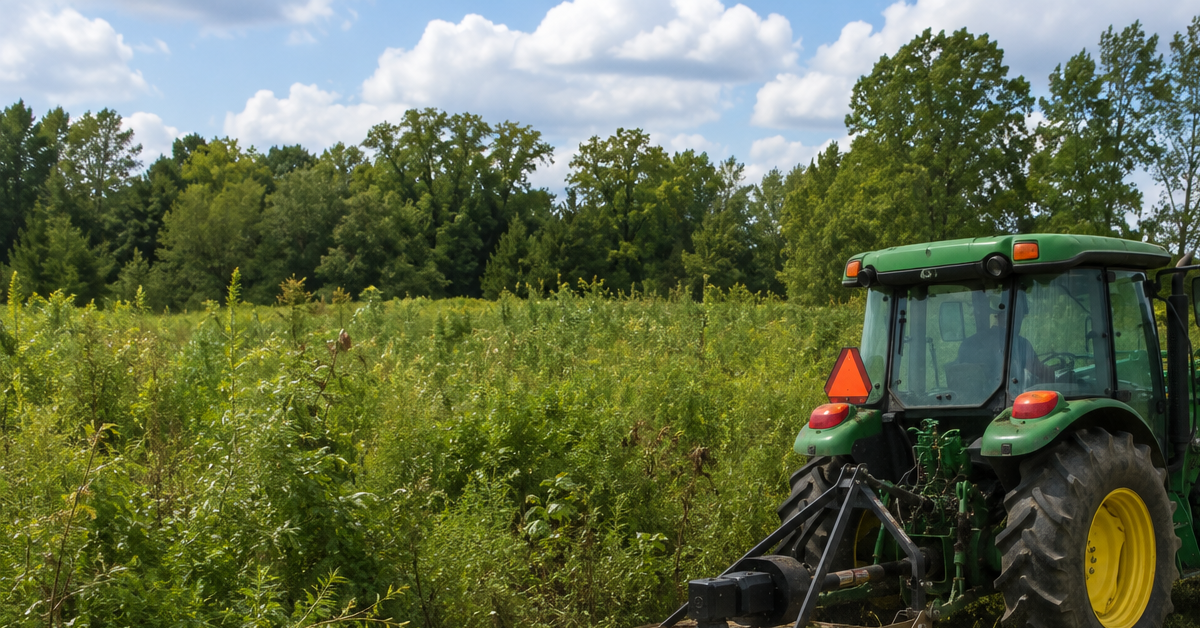
Now you’re standing at the edge of a tangle of chest-high weeds, multiflora rose, and young trees pushing through what used to be open ground.
Before you can do anything useful with that property, you need to be able to see it.
That is the core problem every overgrown property owner faces in Southwest Michigan, and it is exactly what professional brush hogging solves.
Brush hogging is rarely the final step. But for most neglected properties in Battle Creek, Calhoun County, and the surrounding region, it is almost always the right first one.
What Brush Hogging Actually Does:
A brush hog is a heavy-duty, tractor-mounted rotary cutter built to handle vegetation that a standard mower would destroy itself trying to cut.
The heavy blades slice through briars, tall grasses, dense weeds, and woody saplings up to two or three inches thick. Everything is mulched in place. No hauling, no grading, no soil disturbance.
This is not the same as full land clearing. Land clearing involves removing stumps, grading soil, and hauling off debris. That is a bigger, more expensive scope of work.
Brush hogging is faster, less invasive, and in many cases, the right and only level of intervention needed to open a property and make everything else possible.
Think of it this way: the goal is to go from a jungle to a cleared field. You may still have work ahead, but once the overgrowth is gone, you can walk the land, see what is actually there, and make real decisions.
Why Southwest Michigan Properties Get Overgrown So Fast:
Michigan’s growing season is generous, and the region around Battle Creek gets warm summers with consistent rainfall.
For unmanaged land, that is not a good thing. Opportunistic and invasive plants thrive aggressively. A field that looks manageable in spring can be nearly impenetrable by late August.
Here are the biggest offenders in Calhoun County and surrounding areas:
Multiflora Rose:
Originally planted as a living fence and wildlife cover, multiflora rose now spreads aggressively throughout Southwest Michigan.
It forms dense, thorny thickets that can take over a pasture in just a few seasons. The Michigan Invasive Species Program lists it among the most damaging plants on rural and agricultural land across the state.
Autumn Olive and Buckthorn:
Both produce berries eaten by birds, which spread seeds across open ground. They grow quickly, shade out native plants, and become harder to remove every year you wait.
Phragmites:
The invasive common reed is a persistent problem along drainage ditches, pond edges, and low-lying areas throughout the Kalamazoo River watershed.
Once established, phragmites crowds out native vegetation and reduces the functional value of wetland margins. Mechanical clearing alone rarely eliminates it.
Volunteer Trees:
Cottonwood, box elder, and silver maple are prolific seeders. In an unmanaged field after a wet Michigan spring, they can grow from seedlings to small trees in two or three growing seasons.
Add in the freeze-thaw cycles that weaken standing dead wood, and you have hazards that remain invisible until something falls.
For guidance on identifying invasive plants on your property, MSU Extension’s invasive species resources offer identification tools and management recommendations specific to Michigan.
The Real Cost of Skipping Brush Hogging:
It is tempting to think you can skip straight to the “real” work and deal with the brush along the way.
In practice, that almost always costs more and takes longer than doing it right the first time.
Hidden Hazards Become Expensive Problems:
Dense vegetation hides old fence wire, buried debris, tree stumps, and soft ground.
Running heavy equipment through uncleared land risks equipment damage, flat tires, and injury. Finding those hazards before work begins is basic safety, not optional preparation.
Tree Assessment Becomes Guesswork:
It is nearly impossible to evaluate the health and structure of a tree when it is surrounded by dense brush.
An accurate assessment requires clear sightlines and access around the base of each tree. Without that access, you may pay to remove trees that do not need to come down, or miss genuine hazards that do. Our tree health care services depend on clear access to give property owners honest, accurate evaluations.
Invasive Plants Gain Ground Every Season:
Multiflora rose, autumn olive, and phragmites do not pause while you decide what to do.
Every year of delay gives invasive species more root depth, wider spread, and significantly more difficulty to manage. Brush hogging now prevents a far more expensive eradication project two or three years from now.
Emergency Response Is Slower on Cluttered Properties:
When a Southwest Michigan storm drops a tree across your driveway or fence line, clearing it safely on an overgrown property takes more time and more crew.
Our 24/7 emergency tree service responds faster and works more safely on properties that are already accessible.
What Brush Hogging Makes Possible:
Once the overgrowth is cleared and you can walk the land, a practical property plan becomes achievable.
A Real Tree Inventory:
With brush cleared, a tree care professional can assess every tree on the property, finding dead, diseased, and structurally compromised trees before they become emergencies.
Safer and More Efficient Tree Removal:
When large or hazardous trees need to come down, clear access lets crews position equipment correctly and work without obstacles. With tree and stump removal, site access directly affects both cost and safety.
Drainage Issues Become Visible:
Michigan’s clay-heavy soils and freeze-thaw patterns create drainage challenges that are completely invisible under dense growth.
Brush hogging regularly reveals low spots, old drain tile, and erosion channels that need attention before any construction or improvement project can move forward.
Fence Line Restoration:
Many rural Calhoun County properties have old fence lines buried under decades of growth. Clearing them is a requirement before any fencing project, and brush hogging makes it feasible without destroying equipment on hidden wire.
Habitat and Pasture Restoration:
For landowners wanting to restore native grassland, establish food plots, or return old pasture to productive use, brush hogging is the starting point before any seeding or planting can succeed.
How a Professional Crew Evaluates an Overgrown Property:
When Brawner’s Tree Service visits a property in Battle Creek or across Southwest Michigan, the process starts with a thorough walkthrough before any equipment is brought in.
Every good assessment asks the same core questions:
- What is the density and species makeup of the growth? Light brush is handled differently from established invasive thickets.
- Are there large or hazardous trees that need to be addressed before clearing begins?
- What is the long-term goal for the property?
- What are the equipment access constraints, including slope, soil moisture, and gate clearance?
For most overgrown properties, the recommended sequence is: brush hog accessible areas first, assess what is revealed, then address specific tree hazards and secondary clearing as needed.
This staged approach keeps costs predictable and avoids the expensive surprises that come from rushing in without a plan.
For properties with significant wooded acreage, our forestry management services can extend the project from initial clearing into a long-term land stewardship plan.
Homeowner tip: Before the site visit, note where you have seen standing dead trees, any consistently soft or wet ground, and any buried debris or old wire you know about. That context helps the crew plan efficiently and protects equipment.
When Brush Hogging Alone Is Not Enough:
Brush hogging handles surface vegetation and light woody material well. But some properties need more.
If your land also includes any of the following, a broader plan is necessary:
- Mature invasive trees such as large autumn olive, tree of heaven, or established buckthorn that have grown beyond the reach of a rotary cutter
- Active storm damage with downed or hanging trees that pose immediate hazards
- Stumps and root systems left from previous clearing work
- Dense phragmites stands that require herbicide treatment alongside mechanical clearing
- Timber-value trees that may warrant a logging assessment before any clearing begins
Brush hogging gives you a cleared canvas. Professional tree removal, stump grinding, and land management build on that foundation.
Southwest Michigan’s weather adds urgency to all of this. Late-winter ice storms, spring tornado events, and the high-wind systems that move through Calhoun County regularly create emergency situations on short notice. A cleared, accessible property handles those events far more safely than an overgrown one.
A Note on Underground Utilities:
Brush hogging does not disturb soil, but any property work in Michigan should start with a call to MISS DIG 811, Michigan’s utility notification system.
Under state law, all underground utility lines must be located before any excavation begins. It is free, it is legally required, and it protects everyone on site.
Frequently Asked Questions:
How much does brush hogging cost in Southwest Michigan?
Pricing varies based on acreage, density of growth, terrain, and equipment access. Most jobs in the Battle Creek and Calhoun County area are priced by the acre or by the hour. A site visit is always the first step before any estimate can be given.
What is the best time of year to brush hog in Michigan?
Late summer through early fall works well for most properties. Growth has slowed, ground is firm, and clearing now sets you up for spring planting or construction. Late winter, before green-up, is also a strong window. Avoid periods of very wet soil.
Will brush hogging kill invasive plants like multiflora rose?
It cuts them back but will not kill established plants with deep root systems. Effective control of multiflora rose, autumn olive, or phragmites typically requires repeated mowing combined with targeted herbicide treatment.
Is brush hogging the same as land clearing?
No. Brush hogging removes surface vegetation. Land clearing is more intensive and includes felling trees, grinding stumps, grading, and debris removal. Brush hogging is often the first phase of a land clearing project.
How long does a typical job take?
A one-to two-acre residential property with moderate overgrowth can often be completed in a few hours. Larger parcels, heavier brush, or difficult terrain will take longer. Your contractor will give a realistic estimate after the site walkthrough.
Do I need a permit to brush-hog my property in Michigan?
For most private land, no permit is required. If your property includes regulated wetlands or protected natural areas, restrictions may apply. Check with your local municipality or a land management professional if you are unsure.
Can brush hogging damage underground utilities?
No, because it only cuts above-ground vegetation. That said, all operators should know the locations of buried utilities before bringing heavy equipment onto any property. Contact MISS DIG 811 before work begins.
Take Back Your Property:
Overgrown properties in Southwest Michigan do not improve on their own.
Invasive species build deeper roots. Storm-damaged trees become more unstable. Fence lines disappear under years of growth. Every season of delay adds cost to the project.
Brush hogging changes that. It gives you visibility, access, and options. It creates the foundation on which every other improvement to your property depends.
At Brawner’s Tree Service, we have helped property owners throughout Battle Creek, Calhoun County, and Southwest Michigan reclaim land they were not sure was manageable.