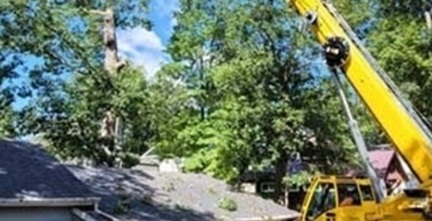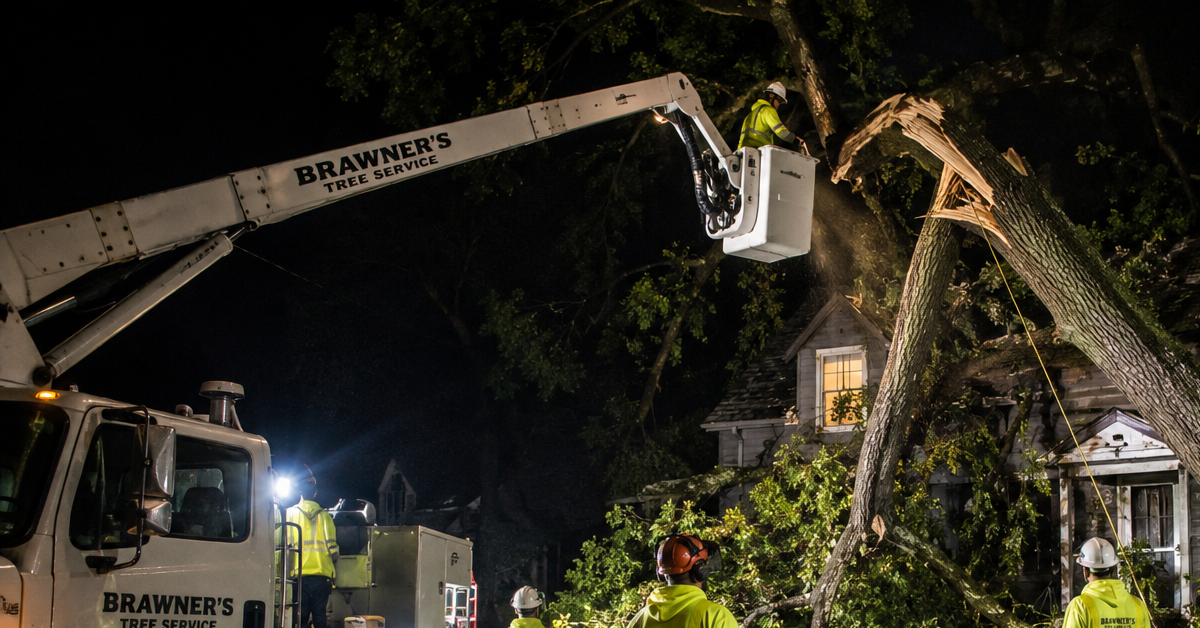
A large limb comes down at 11 pm on a Sunday night. It punches through your porch roof, takes out a section of fence, and blocks your driveway.
You are not going to wait until Monday morning to deal with it.
This is the situation that 24/7 emergency tree service was built for. But many Calhoun County homeowners have never needed it before and do not know what to expect when they call, what qualifies as a true emergency, or what happens after a crew arrives in the middle of the night.
This guide covers all of it, based on what we actually see and do on emergency calls throughout Southwest Michigan.
Key Takeaways:
- Emergency tree service covers situations that create immediate risk to people or structures.
- True 24/7 availability means crews respond at any hour, including nights, weekends, and holidays.
- Emergency calls are triaged by urgency, not by order received.
- Emergency response typically costs more than scheduled tree work due to after-hours staffing and rapid deployment.
- Homeowners can take specific steps to stay safe and protect their insurance claim while waiting for the crew’s arrival.
- Not every post-storm situation requires emergency response, but a professional should make that call, not the homeowner.
What Is 24/7 Emergency Tree Service?
24/7 emergency tree service is professional tree care available at any hour of the day or night, including weekends and holidays, to address hazardous tree situations that cannot safely wait for a standard appointment. It covers fallen trees on structures, hanging branches over occupied areas, storm-split trunks, and any tree condition that poses an immediate risk to people or property.
Why Is Emergency Tree Service Important in Calhoun County?
Calhoun County and the broader Southwest Michigan region experience severe weather events year-round: ice storms in late winter, tornado-producing thunderstorms in spring and summer, and high-wind events that cross the region in every season. Trees stressed by Michigan’s freeze-thaw cycles are more likely to fail during these events, and when they do, the hazard does not wait for business hours.
When Should You Call for Emergency Tree Service?
Call immediately if a tree or large limb has fallen on a structure, vehicle, or utility line, or if a broken branch is hanging over an occupied area. Call if a tree is visibly leaning at a new angle after a storm, if you hear active cracking from a tree near your home, or if storm damage has made a tree an immediate safety threat to anyone on the property.
What “24/7 Available” Actually Means in Practice:
When a tree service company says they are available 24/7, that means a qualified crew can be dispatched at any hour. It does not mean a five-minute response time.
Response time depends on how many active emergency calls are in the queue, crew location, road conditions, and the severity of your situation relative to others.
In our experience responding to emergencies across Battle Creek, Marshall, Albion, Springfield, and Calhoun County, most urgent residential calls are reached within one to three hours. During widespread storm events affecting the entire region, response times extend as crews work through multiple properties.
When you call, be specific about what happened and what the immediate hazard is. Dispatch uses that information to prioritize. A tree through a bedroom roof takes priority over a large limb blocking a side gate.
Note : 24/7 availability is real, but response time varies. Accurate information when you call helps ensure your situation is triaged correctly.
What Qualifies as a True Emergency:
Not every storm-related tree situation requires emergency response, and understanding the difference can save you significant money.
True emergencies include:
- A tree or major limb fallen on a house, garage, vehicle, or fence with structural damage
- Hanging or partially attached branches directly over occupied living areas
- Tree making active cracking or splitting sounds after a storm
- Tree leaning significantly at a new angle after a storm event
- Any tree in contact with a power line
Situations that can wait for next-business-day scheduling:
- A tree that has fallen in a yard away from structures, vehicles, and utility lines
- Storm debris, small branches, and minor crown damage
- A tree that needs assessment but shows no immediate hazard
We frequently see homeowners in Battle Creek and across Calhoun County calling for emergency response on situations that could have waited until morning, which means they paid emergency rates for standard work. If you are unsure, call and describe the situation. An experienced dispatcher can help you determine whether you need an immediate response or a morning appointment.
A common issue on Southwest Michigan properties is that homeowners assume any downed tree requires emergency service. What matters is whether the tree or its parts pose an active, immediate hazard.
What to Do While You Wait for a Crew:
Your safety is the priority before the crew arrives. Follow these steps:
Stay away from the fallen tree and anything it is touching. This includes power lines, your home’s exterior, fencing, or any other structure. Downed electrical lines near a tree are an immediate life-safety hazard.
Call 911 if power lines are involved. Do not approach a downed line under any circumstances. Even if the line appears to be de-energized, it may not be. Contact your utility provider as well. MISS DIG 811, Michigan’s utility notification system, can help you locate underground utilities on your property, but above-ground line contact requires your utility company and potentially emergency services.
Document the damage with photos and video before anything is moved or removed. Your homeowners insurance claim depends on documentation of the original damage. Many property owners in Calhoun County miss out on coverage because debris was moved before they photographed it.
Keep people and pets away from the hazard zone until the crew arrives and clears the area.
Do not attempt to cut the tree yourself. A fallen tree under tension stores enormous energy. Cutting into the wrong section causes the log to kick, roll, or spring with enough force to cause serious injury. This is especially true for any portion of the tree that is still connected to the stump or still lodged against a structure.
What Crews Do Differently on Emergency Calls:
Emergency tree work is not simply regular tree removal at an inconvenient hour.
Crews responding to emergency calls in Calhoun County assess the situation differently from a scheduled job. The first priority is stabilizing any immediate hazard, not completing a clean removal.
That may mean cutting a tree off a roof quickly to prevent further structural damage before moving to full removal. It may mean removing the hanging section of a split trunk while leaving the base for a scheduled follow-up. It may mean working in limited lighting with different equipment than a standard crew would use in daylight.
Professional arborists, as described in the scope of work defined for certified arborist credentials, are trained to identify secondary hazards on site. On emergency calls, that includes looking for other compromised trees or limbs in the area that may have been affected by the same storm event.
After the immediate hazard is resolved, a full tree removal and stump service can be scheduled for whatever cleanup remains.
Note : Emergency response prioritizes hazard elimination. It is not always the same as complete removal in a single visit.
What Emergency Tree Service Costs in Southwest Michigan:
Emergency calls cost more than scheduled work. That is standard across the industry and reflects real costs: after-hours crew pay, rapid deployment, and the complexity of working in non-ideal conditions.
In Southwest Michigan, emergency tree service typically runs 1.5 to 2.5 times standard rates depending on the time of call, complexity, and crew requirements.
Many property owners are surprised to discover that homeowners insurance covers a significant portion of emergency tree removal when a tree has damaged a structure. Coverage typically applies to the removal of the tree from the structure and the repair of the damage. It does not usually cover the removal of a tree that fell in the yard without hitting anything insured.
Document everything before the crew begins work. Get an itemized written estimate when possible. Your insurance adjuster will need this information.
After the Emergency: What Comes Next:
Once the immediate hazard is handled, you are likely left with a stump, debris, and possibly other trees on your property that may have been affected by the same storm event.
We recommend scheduling a comprehensive tree health care assessment of all mature trees on your property following any significant storm event. In our experience, storm events that topple or damage one tree often leave neighboring trees with hidden structural compromise.
Properties with significant canopy cover should also consider a broader forestry management consultation to identify and address at-risk trees before the next storm event.
The Michigan DNR Forest Resources Division provides guidance on responsible forest and tree management on Michigan properties, including information relevant to property owners with significant tree inventories.
For properties where storm events have created clearing needs beyond a single tree, our land clearing services can address larger-scale post-storm cleanup.
How Southwest Michigan Weather Creates Emergency Tree Situations:
Southwest Michigan has a weather profile that creates emergency tree situations throughout the year, not just in winter.
Late-winter ice storms in February and March stress already-weakened trees heading into spring. Severe thunderstorms tracking through Calhoun County from May through September bring microbursts and straight-line winds that can exceed 70 mph. Late-season storms in October and November frequently hit trees before leaf drop, catching full canopies with high wind loads.
Many of the emergency calls we respond to in Battle Creek and surrounding communities involve trees that had been compromised for months or years before the final failure. A structural weakness created by a February ice storm can result in a September emergency when a storm provides the final stress load.
This is why scheduling a professional tree health inspection at least once per year is one of the most effective ways to reduce emergency call risk and cost.
Frequently Asked Questions:
How quickly can Brawner’s Tree Service respond to an emergency call in Calhoun County?
Response time depends on conditions and active call volume. During typical emergencies, we aim to reach Battle Creek and Calhoun County properties within one to three hours. During widespread storm events affecting multiple properties, response times may extend. Call immediately and describe the situation clearly so dispatch can prioritize accurately.
Does homeowners insurance cover emergency tree removal in Michigan?
Most standard homeowners policies cover the cost of removing a tree that has damaged a covered structure such as a home or garage. They generally do not cover the removal of a tree that fell in the yard without hitting a covered structure. Coverage limits and deductibles vary by policy. Document all damage with photos before anything is moved.
What should I do if a tree has fallen on a power line?
Do not approach the tree or the power line. Call 911 and your utility provider immediately. A downed power line is a life-safety emergency that must be handled by utility personnel before tree crews can work safely near it.
Is it safe to cut the fallen tree myself while waiting for a crew?
No. Trees under tension store enormous mechanical energy. Cutting into the wrong section can cause the log to kick, roll, or snap back with serious or fatal force. Leave the tree exactly as it is and keep everyone away until a professional crew assesses and removes it.
What if the damage does not look that serious?
If you are unsure whether a situation qualifies as an emergency, call and describe it. An experienced dispatcher can help you determine whether a same-night response is needed or whether a morning appointment is the right call. Err on the side of calling rather than waiting overnight with a compromised tree near occupied areas.
What happens to the stump after an emergency removal?
Emergency removal typically addresses the immediate hazard, which means the tree is cut and cleared. The stump is usually left for a follow-up stump removal appointment scheduled at a standard rate. This is standard practice and helps keep emergency call costs manageable.
Do I need to be home when the crew arrives?
For emergency calls involving access to your property, it is helpful to be available by phone if not on-site. Crews need to know where on the property the hazard is located and may need information about utilities, structures, or access points. If you cannot be there, leave detailed instructions and make sure the area around the hazard is clear of people and pets.
When a Storm Puts a Tree on Your Home, Every Minute of Delay Has a Cost:
Water gets into your roof. Weight shifts against your structure. Conditions that were manageable at midnight become worse by morning.
Brawner’s Tree Service provides 24/7 emergency tree service throughout Battle Creek, Calhoun County, Marshall, Albion, Springfield, and surrounding Southwest Michigan communities.
When you call, you get an experienced crew that knows how to assess the situation quickly, eliminate the immediate hazard, and protect your property from further damage.