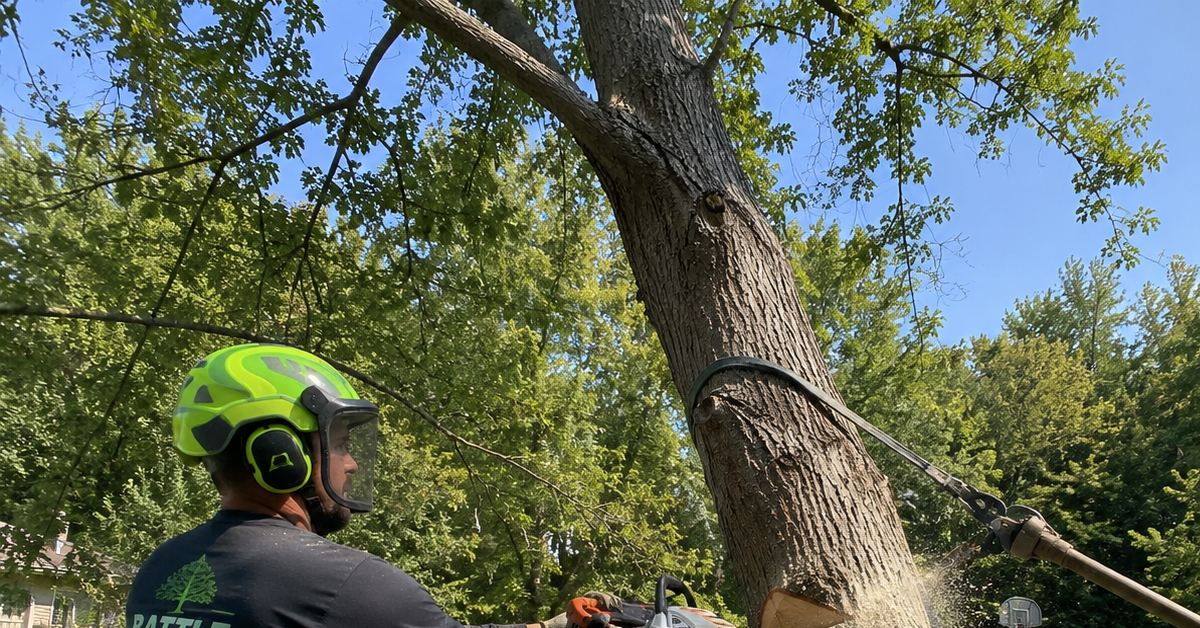
Key Takeaways
- Complexity of Physics: Emergency removals involve unpredictable tension and spring poles that require advanced engineering knowledge to cut safely.
- Safety Protocols: Professional crews use a systematic site command approach to manage power lines, structural integrity, and pedestrian safety.
- Specialized Gear: Unlike standard trimming, emergencies often require cranes, heavy-duty rigging, and high-capacity wood chippers to stabilize the scene.
- Insurance Coordination: Rapid documentation and professional assessments are vital for successful homeowner insurance claims following storm damage.
- 24/7 Readiness: True emergency services in Battle Creek maintain ready-to-roll equipment and crews to respond during weather events.
When a massive thunderstorm or an ice event rips through Battle Creek, the sound of a cracking limb is often followed by a moment of pure panic for homeowners. Whether a century-old oak has split across your driveway or a heavy branch is looming precariously over your power lines, the situation moves from a landscaping issue to a public safety crisis in seconds. Most people see the flashing lights and hear the roar of chainsaws, but few understand the intricate, high-stakes choreography that happens behind the scenes during a professional emergency tree removal.
Removing a tree under normal conditions is a controlled, mathematical process. Removing a tree during an emergency is a battle against gravity, unstable tension, and the unpredictable Michigan elements. This guide pulls back the curtain on the specialized world of emergency arboriculture to show you exactly how professionals keep your property and themselves safe during a crisis.
The Immediate Response: Triage and Site Assessment
The process begins long before a saw touches bark. When an emergency call comes in, the first goal is triage. Much like a hospital emergency room, tree professionals must determine which calls represent an immediate threat to life or structural stability.
- Upon arrival, the crew leader performs a 360-degree site assessment. They aren’t just looking at the fallen tree; they are looking at the strike zone. This includes identifying energized power lines, compromised gas meters, and the structural integrity of the soil.
- In Battle Creek, heavy rains often saturate the ground, meaning a tree that has partially leaned might continue to move as the soil shifts.
- The crew must establish a drop zone and ensure that no bystanders or unauthorized persons enter the perimeter. This initial phase is about stabilization, ensuring the situation doesn’t get worse while the plan is being formulated.
The Hidden Danger: Tension and Compression
The most dangerous part of an emergency removal is the invisible force stored within the wood. When a tree falls and gets caught on another tree or a building, it becomes a giant, organic spring. Arborists refer to these as spring poles or tension wood.
If an amateur tries to cut a limb that is under thousands of pounds of pressure, the wood can split violently, an event known as barber-chairing, or the limb can kick back with enough force to be fatal. Behind the scenes, the crew is calculating these forces. They use specialized cuts, such as the bore cut or the apex cut, to slowly release the internal pressure of the wood. This is a slow, methodical process that requires years of experience to read the grain and predict which way the wood will jump when the final fiber is severed.
Gear of the Trade: Beyond the Chainsaw
Emergency removals in Calhoun County often require more than just a truck and a saw. Because the trees are often in precarious positions, resting on roofs or tangled in wires, the crew must bring in the heavy hitters.
a.) Cranes and Grapple Trucks
In many cases, the safest way to remove a tree from a house is to lift it straight up. Professional emergency crews utilize cranes to pick sections of the tree. A climber will secure a rigging line to a section of the tree, and the crane operator will take the tension. Once the cut is made, the crane whisks the multi-ton log away from the structure, preventing any further damage to the roof or walls.
b.) Rigging Systems
When a crane can’t reach the site, arborists use complex rigging systems involving high-tensile ropes, blocks (pulleys), and friction devices. This allows a ground crew to lower heavy limbs slowly rather than letting them free-fall. This control is essential when working inches away from windows or expensive landscaping.
In Battle Creek, many emergency removals involve Consumers Energy or local municipal power grids. A tree tangled in power lines is a no-go zone for any reputable tree service until the line is cleared or de-energized. Behind the scenes, the tree service is in constant communication with utility lineworkers. Safety protocols dictate that we treat every wire as hot or energized until a utility professional confirms otherwise. This coordination can sometimes add time to the process, but it is a non-negotiable safety standard that prevents electrocution.
The Human Element: Crew Communication
In the roar of chainsaws and wood chippers, verbal communication is nearly impossible. Professional emergency crews use a combination of hand signals and helmet-mounted Bluetooth headsets to stay in constant contact. The ground man is the eyes and ears for the climber. They monitor the surrounding area for shifting soil, changing wind patterns, or equipment failure. This buddy system ensures that someone is always watching the climber’s back while they are focused on the precision of the cut.
Documentation and Insurance Support
While the crew is working, there is often a secondary process happening: documentation. Because emergency removals are frequently covered by homeowners’ insurance, the tree service must document the why and how of the removal. This includes taking photos of the damage, the position of the tree relative to the house, and any signs of pre-existing decay that may have contributed to the failure. This behind-the-scenes administrative work is crucial for the homeowner to get reimbursed for the costs of the emergency service and the repairs to their property.
When a storm hits, and the unthinkable happens, you need a team that reacts with precision and professional calm. Brawner’s Tree Service is the most trusted name for 24/7 Emergency Tree Services in Battle Creek, Kalamazoo, and throughout Calhoun County. With 45 years of combined experience, our family-owned company specializes in high-stakes Tree Removal and hazardous limb stabilization.
We utilize state-of-the-art equipment and advanced rigging techniques to protect your home from further damage, all while maintaining a No Leaf Left Behind policy for a spotless cleanup. Our team is fully licensed and insured, providing you with the peace of mind that comes from working with BBB A+ rated experts. Whether it is a midnight emergency or proactive Tree Health Care to prevent a future fall, we offer honest, affordable service with special discounts for military, first responders, and teachers.
Don’t wait for the next Michigan storm to find your local tree partner. Call us today at (269) 371-5449 for a free estimate and experience the Brawner’s difference.
Frequently Asked Questions
1. What defines a tree removal as a true emergency?
An emergency is any situation where a tree or limb poses an immediate threat to people, pets, or property. This includes trees resting on structures, blocking main driveways, or tangling with utility lines.
2. Should I try to move smaller branches off my roof myself?
Absolutely not. A branch that looks small can be under extreme tension or may be part of a larger, unstable system. Climbing onto a storm-damaged roof is also incredibly dangerous due to potential structural compromises.
3. Does homeowners’ insurance usually cover emergency tree removal?
Generally, if a tree falls on a covered structure (like your house, garage, or fence) due to a storm, insurance will cover the removal. If it simply falls in the yard without hitting anything, coverage may be limited.
4. How long does a typical emergency removal take?
It varies wildly based on the size of the tree and the complexity of the rigging. A standard removal might take 3-4 hours, while a large oak resting on a house could require a full day and a crane.
5. What happens to the wood after an emergency removal?
We offer several options. We can chip the smaller brush, haul away the heavy logs, or leave the wood for you to use as firewood. Our No Leaf Left Behind policy ensures the site is clean regardless.
6. Can a tree be saved after it has partially fallen?
In some rare cases, a leaning tree can be cabled and braced, but if the root plate has lifted from the soil, the tree’s structural integrity is permanently compromised, and removal is usually the only safe option.
7. Do you work during active storms or wait until the wind dies down?
We monitor wind speeds and lightning closely. While we provide 24/7 response, we will pause operations if conditions become life-threatening for our climbers. Safety is always the priority.
8. Is there an extra charge for emergency services compared to scheduled work?
Emergency removals often require immediate crew mobilization, overtime pay, and specialized equipment on short notice, which can result in higher costs than a standard, scheduled removal.
Summary Checklist: Emergency Readiness
| Condition | Risk Level | Recommended Action |
|---|---|---|
| Tree resting on power lines | Critical | Stay clear of the area, contact the utility provider immediately, and arrange emergency professional response |
| Large limb hanging over the roof | High | Keep occupants away from affected interior areas and arrange urgent professional removal |
| Cracking sounds during wind events | High | Clear the hazard zone immediately and request an urgent structural tree assessment |
| Root plate lifting from the soil | High | Treat the tree as unstable and arrange immediate professional evaluation or emergency removal |
| Blocked road or driveway access | Moderate | Arrange prompt emergency clearing to restore safe vehicle and property access |
Final Advice
Dealing with an emergency tree situation is a race against both time and physics, and the most important solution is to never attempt a DIY fix on a storm-damaged tree. The tension stored in fallen timber is deceptive; a single cut in the wrong place can cause a massive trunk to shift or snap with the force of a car accident.
To protect your property, start by taking clear photos from a safe distance for your insurance agent, then immediately establish a no-go zone for your family and neighbors. Your primary responsibility is to keep people away from the hazard until professional help arrives with the correct rigging and safety gear. By hiring a licensed and insured local expert like Brawner’s Tree Service, you ensure that the removal is handled according to the Occupational Safety and Health Administration (OSHA) standards, which minimizes the risk of secondary damage to your home’s foundation or roof.
Remember that prevention is the best emergency plan. Regularly having your trees inspected for internal decay or structural weaknesses can help you identify hazardous trees before the next Battle Creek storm turns them into a crisis. If the worst does happen, stay calm, stay inside, and let the professionals with the right equipment manage the danger.