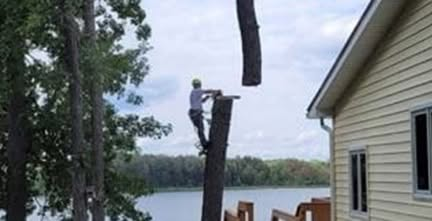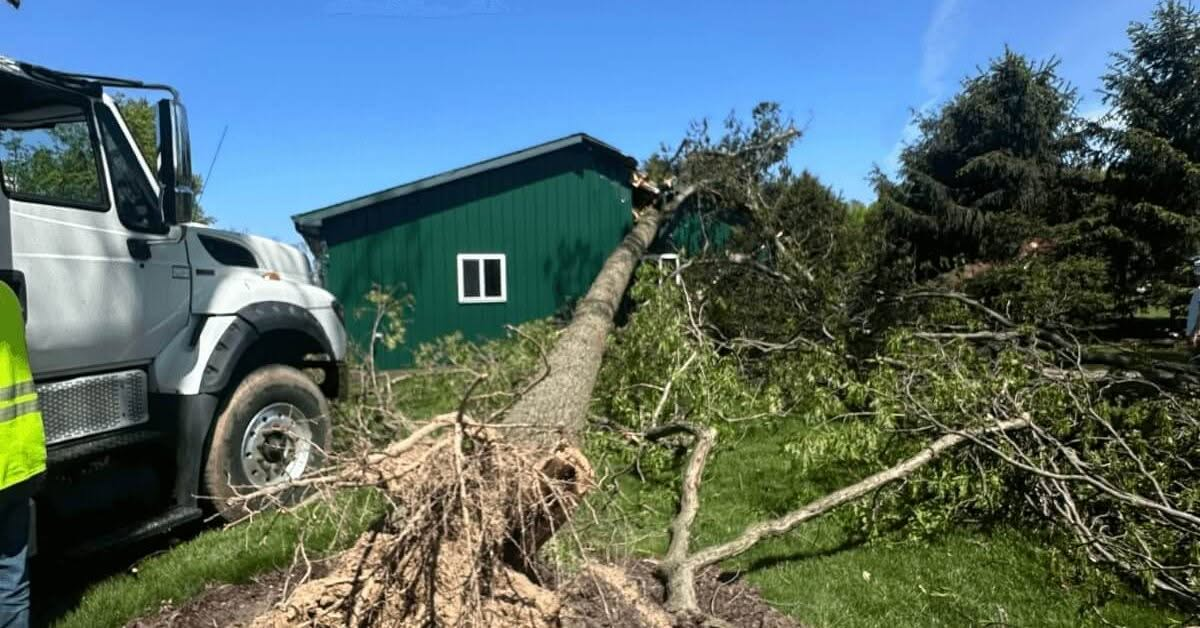
A tree on your Kalamazoo property needs to be removed when it is dead, more than half damaged by a storm, structurally unsound at the trunk or roots, or infected with a disease that can’t be stopped, such as oak wilt or advanced emerald ash borer. Those are the clear cases. Many other trees look worse than they are and can be saved with pruning, cabling, or treatment. This guide covers the signs that mean a tree has reached the end of its safe life, and the signs that mean it is worth keeping. When a tree does have to come down, our tree removal service in Kalamazoo handles it from assessment to cleanup.
Knowing the difference matters here in Southwest Michigan, where wind, ice, wet snow, and heavy clay soil all put stress on mature trees. A tree that fails in Kalamazoo usually gives warning first, if you know what to look for.
What are the signs a tree is dead or dying?
A tree is dead or dying when large parts of the canopy never leaf out, the branches snap dry instead of bending, and the bark peels away to reveal no living tissue underneath. A quick check is to scratch a small spot of bark with your thumbnail. Green and moist underneath means that section is alive. Brown and dry means it is dead.
Common signs of a dying tree include:
- Bare branches or thin, patchy leaves during the growing season
- Brittle twigs that break with a clean, dry snap
- Bark falling off in large sheets or missing in patches
- Mushrooms, conks, or soft crumbling wood at the base or on the trunk
- An increasing number of dead branches year over year
A single dead limb can be pruned out, and a stressed tree can often recover with care. Once roughly a third or more of the canopy is dead, the tree rarely comes back and removal becomes the safer option.
How can you tell if a tree is structurally unsafe?
A tree is structurally unsafe when the trunk is cracked, split, or hollow, when two stems press together in a weak union, or when the roots can no longer hold it upright. These problems often stay hidden until a storm exposes them, which is why they cause the most damage in Kalamazoo’s wind and ice events.
Watch for these structural red flags:
- A vertical crack or seam running up the trunk
- A cavity or soft, decayed hole where a branch once was
- Two trunks joined in a tight V with bark pinched between them, called included bark, which is a weak point prone to splitting
- A sudden or worsening lean, especially with soil cracking or lifting on one side
- Roots that are cut, decayed, or heaving out of the ground
A gradual lean a tree has held for years is usually stable. A new lean after a storm often means the root plate, the mass of roots and soil that anchors the tree, is failing. In our clay-heavy soil that root plate can let go faster than people expect, so a newly leaning tree should be assessed quickly.
Can a diseased tree be saved, or does it need removal?
Some diseases can be managed, but two common ones in the Kalamazoo area usually end in removal: oak wilt and emerald ash borer. Oak wilt is a fungal disease that spreads through connected oak roots and can kill a red oak within a few weeks of infection. Emerald ash borer is a beetle whose larvae feed under the bark of ash trees and cut off the flow of water and nutrients.
Emerald ash borer has killed tens of millions of ash trees across the Midwest, and its larvae are what starve the tree, which is why an infested ash with heavy canopy dieback and small D-shaped exit holes declines so fast, according to Michigan State University Extension. Oak wilt is identified by rapid leaf drop from the top down and is tracked as a serious threat to the state’s oaks by the Michigan Department of Natural Resources.
Early treatment can sometimes protect nearby healthy trees, but a tree already in steep decline from either disease is rarely worth saving. If you suspect oak wilt or emerald ash borer on your property, we can confirm it and recommend whether treatment or removal is the right step.
When is a tree too close to a house or power line?
A tree is too close when its branches touch the roof or siding, its roots reach the foundation, or any part of it grows into a utility line. Limbs resting on a roof drop debris, trap moisture against the house, and give squirrels and insects a path indoors. Roots pushing against a foundation can crack slabs and clog drain lines as the tree grows.
Trees touching power lines are a separate, serious hazard. The lines stay energized and contact can be fatal, so this is never a do-it-yourself job. Removals near utilities have to be coordinated so the work stays safe.
Can a tree be saved instead of removed?
Many trees that look like removal candidates can actually be saved. A tree with a strong trunk and healthy roots but a few weak or overextended limbs is often a good fit for pruning, or for cabling and bracing, which add support to weak unions rather than taking the whole tree down. The deciding factors are the health of the trunk and root system and how much live canopy remains.
Removal becomes the right call when the damage reaches the main structure, the roots, or the majority of the crown. If you are not sure which side a struggling tree falls on, our guide on whether a tree can be saved or needs removal breaks the decision down in more detail.
Do you need a permit to remove a tree in Kalamazoo?
On most private residential property in Kalamazoo you can remove your own tree without a city permit, but trees in the public right-of-way, on commercial sites, or covered by a local ordinance can require approval first. The rules depend on your municipality and on exactly where the tree sits on your lot. It is worth confirming the current requirements before you schedule work, which we cover in our guide on whether you need a tree removal permit in Kalamazoo.
Frequently asked questions
Does a dead tree have to be removed right away?
A dead tree should be removed before the next major storm. Dead wood turns brittle and the roots lose their grip over time, so the longer it stands, the more likely it fails onto something.
Can you remove a tree in winter in Michigan?
Yes, and winter is often a good time here. Frozen ground protects your lawn, bare canopies are easier to work around, and oak removal is safest in the dormant season when the beetles that spread oak wilt are inactive.
Will removing one tree affect the trees around it?
Usually not, but with oak wilt it can. Because oaks share root systems, the connected roots may need to be severed before removal so the disease does not pass to healthy oaks nearby.
How much does it cost to remove a tree in Kalamazoo?
Most tree removals in the Kalamazoo area run from a few hundred to a few thousand dollars, depending on the tree’s height, trunk size, how easy it is to access, and whether stump grinding is included. A small tree in an open yard costs far less than a large one next to a house or power line. For a full breakdown of what drives the price, see our guide on tree removal costs in Kalamazoo.
Can I remove a tree myself?
You can take down a very small tree yourself, but anything large, near a structure, or near power lines is dangerous and usually beyond what homeowner tools and insurance cover. Falling limbs and trunks are unpredictable, and a wrong cut can damage property or cause serious injury. We remove trees of any size with the right equipment and a controlled drop, especially in tight yards.
What happens to the stump after a tree is removed?
After removal you’re left with a stump, which most homeowners grind down to reclaim the space and stop the roots from sending up new shoots. A ground stump also clears a trip hazard and removes a spot where pests and fungus settle in. We can grind the stump as part of the same job so the area is ready for grass, a garden bed, or a new planting.