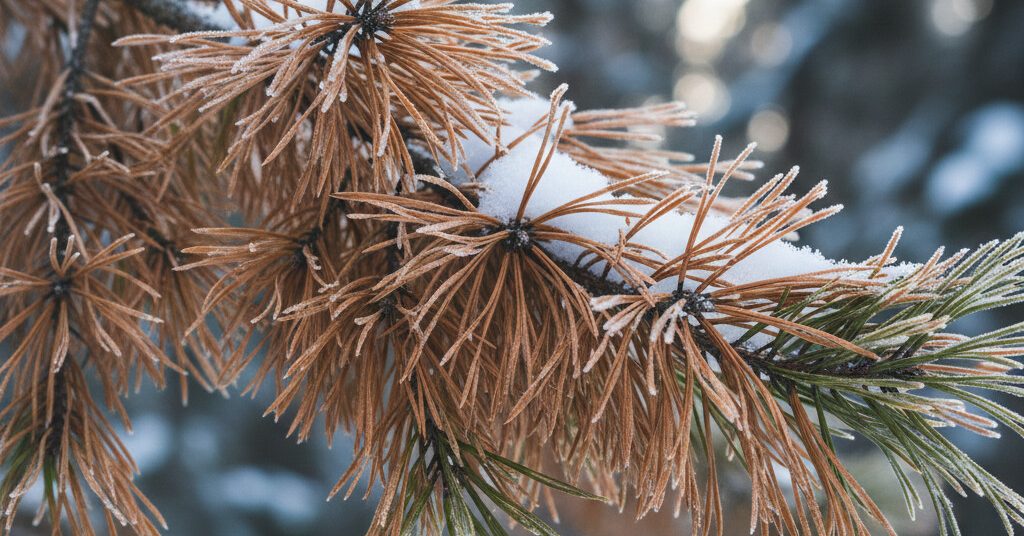
Understanding Winter Browning in Evergreens
For many homeowners across Calhoun County, evergreen trees like pines, spruces, and arborvitae are the backbone of the winter landscape.
It’s normal to see some pine needles turn brown in winter, and in many cases, it’s not a sign of a serious problem. The most common culprit is a condition known as winter burn or “desiccation,” but it is important to understand all the potential causes to provide the right care.
Cold temperatures slow a tree’s ability to move water from the roots to the needles. When the ground freezes, pines can’t absorb moisture properly, which causes older needles to dry out and change color. Winter wind also pulls moisture out of the needles, a process called winter burn, especially on exposed trees.
Another common reason is natural needle drop. Pines don’t keep their needles forever. As part of their normal growth cycle, they shed older, inner needles in fall or winter, which then turn yellow or brown before dropping.
However, if you notice browning on the tips of new needles, large sections of the tree turning brown, or needles falling off early, that can point to stress from drought, poor soil drainage, road salt, or pest and disease issues.
In short, some browning in winter is normal. Widespread or sudden browning is when it’s worth taking a closer look.
Key Takeaways
- Pine needles turning brown in a Calhoun County winter is often caused by “winter burn,” a form of dehydration where needles lose more water to dry winds than frozen roots can absorb.
- While some browning can be a natural part of the tree’s life cycle (seasonal needle drop), widespread browning, especially on the outer parts of the tree, usually signals an underlying issue.
- Other causes can include fungal diseases like needle cast or blight, which often have specific patterns of browning, and environmental stressors like road salt damage or nutrient deficiencies.
- Prevention is key. You can protect your pines by providing deep, thorough watering in the fall before the ground freezes, applying a protective layer of mulch, and using burlap wraps or anti-desiccant sprays on vulnerable trees.
A Field Story from a Pine Grove in Portage
Last winter, we received a call from a homeowner in Portage who was concerned about a stand of mature white pines that were showing significant browning on their south-facing side. The trees were well-established and had always been healthy, so the sudden change was a mystery.
Upon inspection, we determined the trees were suffering from severe winter burn. The previous fall had been relatively dry, and the trees were located in an open, windy area. The combination of direct winter sun and persistent winds had pulled a great deal of moisture from the needles. With the ground frozen solid, the roots were unable to replenish this lost water. The browning was a direct result of this dehydration.
For the immediate problem, there was little to be done but wait for spring to see how the trees would recover. However, we implemented a proactive Tree Health Care plan for the following fall. This included a deep-root watering to ensure the trees were fully hydrated before the ground froze, and the application of an anti-desiccant spray. These sprays create a waxy coating on the needles that helps seal in moisture. The following winter, the browning was significantly reduced, and the pines remained healthy and green.
The Primary Culprit: Winter Burn (Desiccation)
Winter burn is the most frequent cause of browning needles on evergreen trees in Michigan. It is not a disease but a physiological condition; essentially, the tree is drying out.
How Winter Burn Happens
- Water Loss: Even in winter, evergreen needles continue to lose water through a process called transpiration. According to the Ontario Ministry of Agriculture, this water loss is accelerated by dry winter winds and direct sun.
- Frozen Ground: Once the ground freezes, the tree’s roots are unable to absorb water from the soil to replace what is lost through the needles.
- The Result: The needles continue to lose moisture until their internal cells are damaged and die, at which point they turn brown, yellow, or reddish-brown. As the University of Wisconsin Extension notes, symptoms often appear in late winter or early spring and are typically most severe on the side of the tree exposed to the prevailing winds (usually the south or southwest side).
Other Common Causes of Browning Pine Needles
While winter burn is the most common issue, other factors can cause pine needles to turn brown. It is important to look at the pattern of browning to help identify the cause.
Natural Needle Drop
Pines and other evergreens do not keep their needles forever. It is normal for them to shed their oldest, innermost needles each fall.
- Pattern: Browning and dropping of needles on the inside of the tree, closest to the trunk. The new growth at the tips of the branches remains green and healthy.
- When it Occurs: Primarily in the late summer and fall, not in the middle of winter.
Fungal Diseases
Several fungal diseases can cause needle browning, and they often have distinct symptoms.
- Needle Cast Diseases (e.g., Lophodermium, Ploioderma): These fungi infect needles in one season, but the symptoms, browning and needle drop, do not appear until the following spring. This can easily be mistaken for winter burn. According to Michigan State University Extension, a key difference is that needle cast often causes distinct spots or bands on the needles.
- Needle Blight Diseases (e.g., Dothistroma, Brown Spot): These also cause browning and spots on the needles. University of Maryland Extension notes that brown spot often appears in late summer, while Dothistroma symptoms typically show up in the spring on the lower half of the tree.
Environmental and Site Issues
Salt Damage: If your pine tree is near a road or driveway, salt spray can directly damage the needles, causing them to turn brown. Salt in the soil can also be absorbed by the roots, which can be toxic to the tree. Browning from salt damage is usually most pronounced on the side of the tree facing the road.
Drought Stress: A pine tree that was stressed by drought during the growing season may show browning needles as it enters winter. The damage occurred months earlier, but only became apparent as the tree’s systems slowed down.
Nutrient Deficiency: A lack of essential nutrients, such as nitrogen or magnesium, can sometimes cause needles to turn yellow or brown. This is usually a more generalized color change across the entire tree rather than browning in a specific pattern.
Prevention Plan: How to Protect Your Pines This Winter
| Problem | Symptoms | Solution / Prevention |
|---|---|---|
| Winter Burn | Browning on the side of the tree exposed to sun and wind; often appears in late winter/early spring. | Deep Fall Watering: Soak the root zone before the ground freezes. Mulch: Apply 2-4 inches to insulate roots. Wraps: Use burlap on vulnerable evergreens. Anti-Desiccant: Professional spray to seal in moisture. |
| Natural Needle Drop | Browning of the oldest, innermost needles; occurs in the fall. | No action needed. This is a normal and healthy process for the tree. |
| Fungal Diseases | Distinct spots or bands on needles; browning may occur in specific patterns (e.g., lower half). | Professional Diagnosis: Identify the specific pathogen. Fungicides: Timed application to protect new growth. Airflow: Trimming to reduce moisture buildup. |
| Salt Damage | Browning most severe on the side facing a road or salted walkway. | Barriers: Block spray with burlap screens. Alternatives: Use sand or plant-safe de-icers. Soil Flush: Heavy watering in spring to leach out salt. |
How Brawner’s Tree Service Can Help
Our team of experienced tree care professionals can help you diagnose and manage browning needles on your pine trees.
- Diagnosis: We can accurately identify whether the issue is winter burn, a fungal disease, or another environmental stressor.
- Proactive Treatments: We offer services like deep-root watering and the application of anti-desiccant sprays to prepare your trees for winter.
- Disease Management: If a fungal disease is present, we can develop a treatment plan that may include targeted fungicide applications and corrective pruning.
- Expert Pruning: Our Tree Trimming services can improve airflow to reduce disease pressure and remove any branches that have been killed by winter damage, improving the tree’s appearance and health.
Frequently Asked Questions
Will the brown needles on my pine tree turn green again?
No. Once a needle has turned brown, it is dead and will not recover. A healthy tree will produce new growth in the spring to replace the damaged needles.
Should I cut off the brown branches?
It is best to wait until spring to see the full extent of the damage. Some branches that appear dead may still have living buds that will produce new growth. Once you can clearly see what is dead, those branches can be pruned off. For a large tree, it is best to have this done professionally.
I see a lot of brown needles on the ground under my pine tree in the fall. Is this bad?
This is likely just the natural, seasonal shedding of old needles and is not a cause for concern. The key is to look at the new growth at the tips of the branches, which should remain green.
Can winter burn kill my tree?
In severe cases, or if a tree is already stressed, extensive winter burn can be fatal. However, in most cases, a healthy, mature tree will survive and recover, although its appearance may be affected for a season or two.
How can I tell the difference between winter burn and a needle cast disease?
It can be difficult, as the symptoms can appear at the same time (in the spring). The best way to tell is to look closely at the brown needles. Needles affected by a fungal disease will often have small, dark spots or bands on them, which are the fruiting bodies of the fungus. Winter-burned needles will typically be a uniform brown color. If you are unsure, a professional diagnosis is your best bet.