Key Takeaways
- Cabling can extend the safe life of a structurally compromised live oak without resorting to full removal.
- The technique works best on trees with sound trunks and root systems but weak limb unions or included bark.
- Not every structural issue is a good candidate for cabling; some conditions still require removal for safety.
- Live oaks’ size and canopy spread make them particularly good candidates for cabling when the underlying wood is healthy.
- A professional assessment is essential to determine whether cabling will provide lasting, reliable support.
Mature live oaks are among the most valued trees in Jacksonville, Florida prized for their sprawling canopies, dramatic limb structure, and the decades, sometimes centuries, of growth they represent. When one of these trees develops a structural weakness, the instinct to protect it rather than remove it is understandable. Tree cabling is one of the primary tools a dedicated tree service firm in Jacksonville, FL will use to support a structurally compromised tree without removing it entirely, but it isn’t the right solution for every situation.
What Tree Cabling Actually Does
Cabling involves installing a flexible steel cable, typically high up in the canopy, between two major limbs or leaders to help distribute the load between them and limit how far they can separate under stress from wind, rain-soaked canopy weight, or the tree’s own growth over time. The goal is not to eliminate movement entirely, since some flexibility is normal and even necessary for a tree’s health, but rather to prevent a weak union from separating catastrophically during a high-stress event like a storm.
Cabling is typically installed by a professional using specialized hardware designed for this purpose, positioned at a calculated point in the canopy to provide effective support without damaging the limbs it connects. This is different from simply tying a rope or chain between branches, which can girdle or damage the bark and does not provide the engineered support a proper cabling system offers.

Why Live Oaks Are Often Good Cabling Candidates
Live oaks have a naturally sprawling growth habit, often developing multiple large leaders or codominant limbs from relatively early in their growth, rather than a single dominant central trunk. This growth pattern, while part of what gives mature live oaks their iconic wide canopy, also creates more opportunities for included bark and weak unions to develop between major limbs over the tree’s long lifespan.
Because live oaks are typically strong, long-lived trees with generally sound wood when healthy, a weak union caused by growth habit rather than decay is often a good candidate for cabling. The rest of the tree’s structure, including its trunk and root system, may be entirely sound, meaning the specific weak point can be addressed directly rather than requiring removal of an otherwise healthy, valuable tree.
Signs a Live Oak Might Be a Good Candidate for Cabling
Before deciding on cabling, it is important to assess the tree’s overall health and structure. The following signs can indicate that cabling may be worth considering.
Included Bark at Major Limb Unions
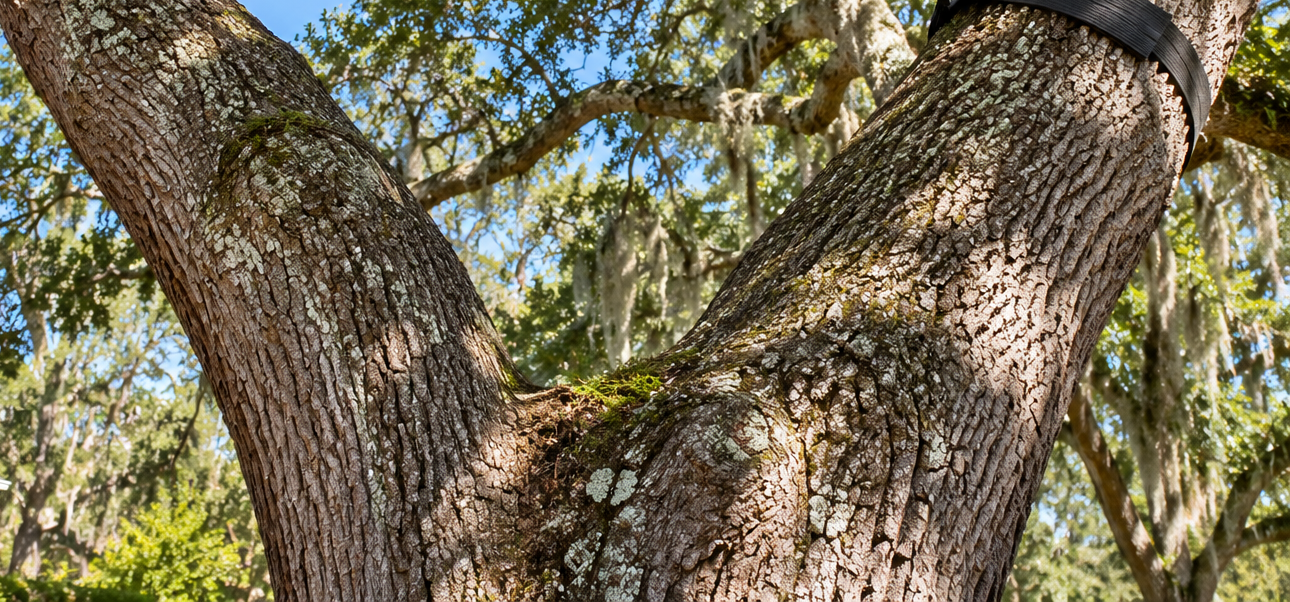
Included bark occurs when two limbs grow closely together at a narrow angle, trapping bark between them rather than forming a strong, fused connection. This creates a structurally weaker union than a wide-angle branch attachment, and these unions are more prone to splitting, particularly under the weight of a full, wet canopy or during high wind. When included bark is identified early, before any splitting has occurred, cabling can provide preventive support that significantly reduces the risk of future failure at that union.
Heavy, Wide-Spreading Limbs
Live oaks are known for producing exceptionally long, heavy horizontal limbs that can extend impressive distances from the trunk. Over time, the sheer weight of these limbs, combined with their leverage relative to the trunk, can place significant stress on the point where they attach. Cabling can help support these limbs, reducing the load at the attachment point and lowering the risk of the limb tearing away, particularly during storms.
Previous Storm Stress Without Structural Failure
A live oak that has weathered a significant storm without any limbs breaking, but shows visible stress at a major union, such as slight separation or bark cracking, may be a good candidate for cabling to reinforce that union before a future storm causes it to fail completely.
Sound Trunk and Root System
Perhaps the most important factor in determining whether cabling is appropriate is the condition of the tree’s trunk and root system. Cabling only addresses the specific limb union or leader it’s installed on; it does nothing to address decay in the trunk or instability in the root system. A tree with a healthy trunk and stable roots, but a weak limb union, is generally a much better cabling candidate than a tree with multiple compounding structural issues throughout.
When Cabling Is Not the Right Solution
Cabling is not appropriate for every structurally compromised tree, and it’s important to understand its limitations.
- Significant trunk decay undermines the entire structural support system that cabling relies on; a cable between two limbs cannot compensate for a compromised trunk beneath them.
- Substantial root damage or instability means the whole tree, not just a specific limb union, is at risk, and cabling does not address this underlying problem.
- A limb union that has already split or begun separating is usually too damaged for cabling to provide reliable support. In such cases, removing the affected limb or, if necessary, the entire tree is often the safer option.
Multiple Compounding Issues
A live oak with several structural concerns at once, such as included bark at more than one union combined with signs of trunk decay, presents a more complex risk profile than a single, isolated weak point. While cabling can sometimes be part of a broader management plan for a tree with multiple issues, the overall recommendation in these cases depends heavily on a professional’s assessment of the cumulative risk.
The Long-Term Commitment of Cabling
Choosing cabling over removal is not a one-time decision; it represents an ongoing commitment to monitoring and maintaining the support system over time. Cables should be inspected periodically to confirm they remain properly tensioned and that the tree’s growth hasn’t affected how the hardware interacts with the limbs it supports. As the tree continues to grow, adjustments may occasionally be needed to ensure the cabling system continues to function as intended.
Homeowners considering cabling should view it as an investment in preserving a valuable tree, one that requires periodic professional check-ins, rather than a permanent fix that can be installed and forgotten.
Weighing the Value of the Tree Against the Cost of Support
For a young or moderately sized tree, the cost and ongoing commitment of cabling may not make sense compared to simply removing and replacing the tree. For a mature live oak that has taken many decades to reach its current size and canopy spread, the calculation often looks different. These trees provide substantial shade, contribute significantly to property character and value, and cannot be replaced on any reasonable timeline, which is why many Jacksonville homeowners choose to invest in cabling and ongoing structural support rather than removing a tree that could otherwise remain a safe, valuable feature of their property for decades to come.
Getting a Professional Assessment
Because the decision between cabling and removal depends on a detailed understanding of a tree’s internal condition, not just what’s visible from the ground, a professional assessment is essential before moving forward with either option.
Bushor’s Tree Surgeons can help protect mature live oaks by assessing structural weaknesses before they lead to serious failure. Our ISA-Certified Arborists evaluate limb unions, included bark, trunk condition, root stability, and overall tree structure. When cabling is appropriate, we design a support system based on the tree’s specific needs.
Bushor’s Tree Surgeons uses high-strength cables and properly sized hardware for reliable support. Dynamic or static cabling may be used depending on the level of structural weakness. Structural pruning can also be combined with cabling when additional support is needed. Bushor’s follows ANSI A300 standards and provides professional installation to help preserve healthy, valuable trees.
Frequently Asked Questions About Cabling Mature Live Oaks in Jacksonville, FL
What is tree cabling, and how does it work?
Cabling involves installing a steel cable high in the canopy between two major limbs to help distribute stress and limit dangerous separation during storms or heavy canopy loading.
Is cabling a permanent solution?
Cabling requires ongoing monitoring and occasional adjustment over time; it’s a long-term support method rather than a one-time, permanent fix.
Can cabling fix a tree with trunk decay?
No, cabling only addresses the specific limb union it’s installed on and cannot compensate for decay or instability in the trunk or root system.
Why are live oaks often good candidates for cabling?
Their sprawling growth habit frequently produces included bark and weak limb unions, while the rest of the tree, including the trunk, often remains structurally sound.
How do I know if my live oak’s limb union is a cabling candidate?
A professional assessment can determine whether the union shows early signs of weakness that cabling can address, versus more advanced separation that requires removal.
Does cabling prevent all limb failure during storms?
Cabling significantly reduces risk at the specific point it supports but cannot eliminate all risk, particularly during extreme weather events.
How much does tree cabling typically cost compared to removal?
Costs vary based on tree size and the complexity of the installation, but cabling is often more affordable than removing and replacing a large, mature tree, especially over the long term.
How often does a cabled tree need to be inspected?
Periodic inspection, often as part of a broader tree maintenance schedule, helps confirm the cabling system remains properly tensioned and effective as the tree grows.
Summary Checklist: Live Oak Cabling vs Removal Evaluation
| Evaluation Area | What to Confirm |
| Limb union condition | Look for included bark or early signs of separation |
| Trunk integrity | Confirm the trunk is free of significant decay |
| Root system stability | Rule out signs of root damage or instability |
| Extent of existing damage | Determine if the union has already failed |
| Number of structural issues | Assess whether problems are isolated or compounding |
| Long-term commitment | Understand ongoing monitoring cabling requires |
| Professional assessment | Schedule an evaluation before choosing a path forward |
Final Advice
If you are considering cabling for a mature live oak, have the tree inspected before making any decision. Do not install cables yourself or use ropes or chains as a substitute for a professionally designed support system. Ask an arborist to check whether the trunk and roots are strong enough to support cabling. Address weak limb unions early, before cracks or separation become more severe. If cabling is recommended, plan for regular inspections and adjustments as the tree grows. Choose a qualified, licensed, and insured tree service that follows recognized arboricultural standards.
For Jacksonville homeowners, Bushor’s Tree Surgeons can evaluate your live oak and recommend the safest approach for preserving it when practical.