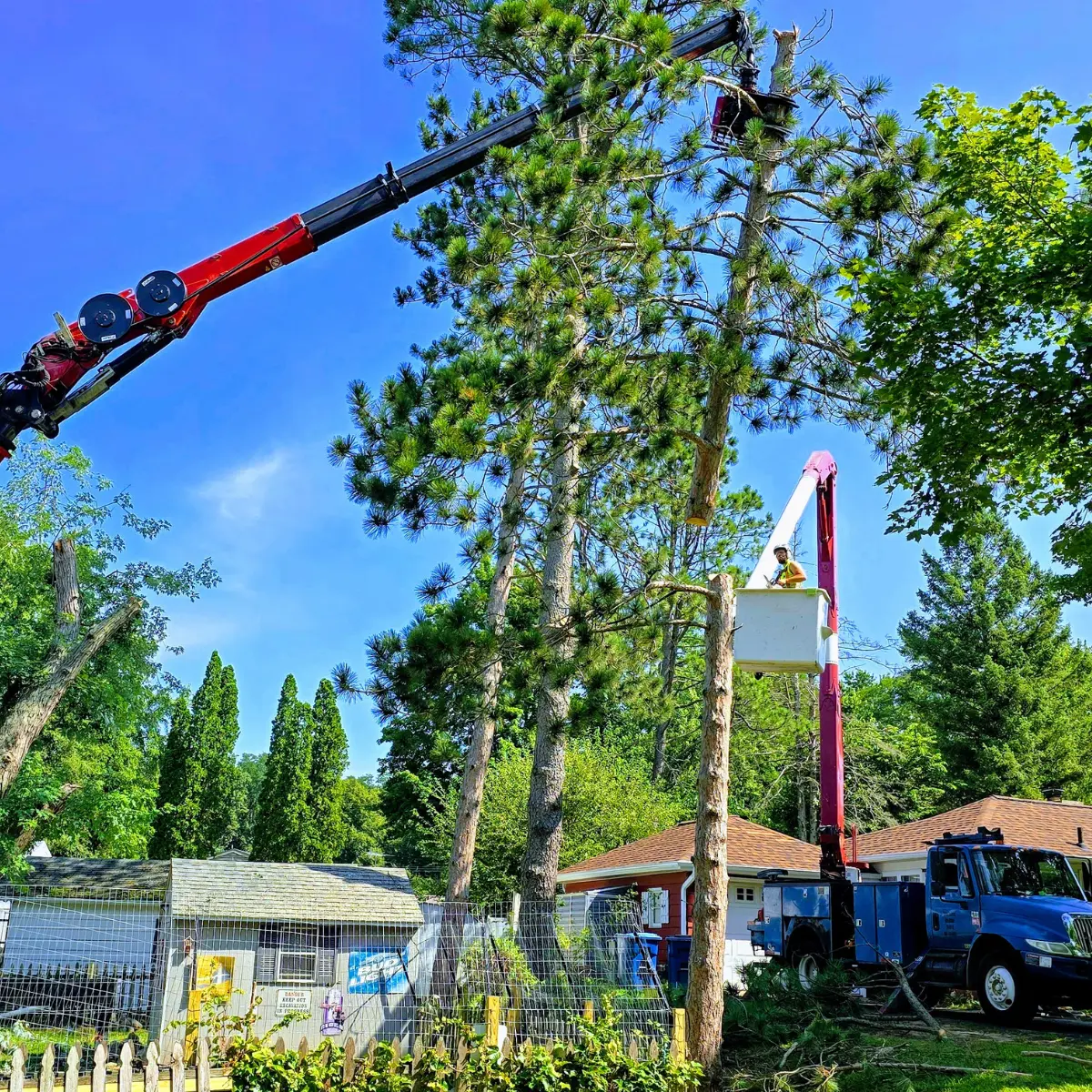
Pruning your oak trees removes dangerous deadwood, builds a stronger branch structure, improves the tree’s health, protects your home from falling limbs, and gives you an early look at problems like decay or cracks. Oaks are some of the longest-lived, heaviest-limbed trees in Michigan, so the work you do now shapes how safe and healthy they stay for decades. The reasons below explain why regular pruning pays off for Michigan property owners, and the timing section covers the one rule that matters most for oaks in our state.
1. It removes dead, damaged, and diseased branches
The first reason to prune an oak is to take out branches that are dead, cracked, or diseased before they fall. Oak limbs are dense and heavy, and in Michigan’s wind and ice storms a failed branch can do real damage to a roof, a vehicle, or anyone underneath. Clearing this wood also stops decay from spreading further into the tree.
Dead and broken limbs are easiest to spot in summer, when the rest of the canopy is full and the bare branches stand out. If you are seeing a growing amount of deadwood each year, that can point to a larger health problem, which we cover in our guide on the signs of a hazardous tree.
2. It builds strong structure in young oaks
Pruning a young oak sets up the strong framework it will carry for the rest of its life. This is called structural or formative pruning, and it means guiding the tree toward one dominant central trunk with well-spaced branches. Done early, it prevents the weak, tight branch unions that split apart in Michigan storms years later.
A red or white oak in Michigan can live well over a hundred years, so a few early pruning cycles have a long payoff. Correcting structure on a young tree takes small, simple cuts. Fixing it on a mature oak means removing large limbs, which is far harder on the tree.
3. It improves airflow and light through the canopy
Thinning an overgrown oak canopy lets more air and light move through the tree, which keeps it healthier. Better airflow helps leaves and bark dry out after rain, and drier surfaces are less friendly to the fungal problems that take hold in the damp, crowded canopies common in our humid Michigan summers. More light reaching the interior also supports stronger inner growth.
The goal is selective thinning, not stripping the tree. Removing too much live canopy at once stresses an oak and forces weak, excessive regrowth, so a light, careful hand matters here.
4. It keeps limbs clear of your home and power lines
Pruning keeps oak branches a safe distance from your roof, siding, and nearby utility lines. Limbs resting on a roof drop debris, trap moisture against the house, and give pests a path indoors. Branches growing toward power lines are a serious hazard and should never be cut by a homeowner, since the lines stay energized.
Keeping that clearance is an ongoing job as the tree grows. Regular pruning holds the canopy back before a limb reaches the house or the lines, rather than waiting for the next Michigan storm to turn it into an emergency.
5. It lets you catch problems early
Every pruning visit is also a close inspection of the tree. Working through the canopy is when cracks, cavities, including bark, early decay, and pest activity show up, often long before they are visible from the ground. Catching these issues early means a small correction instead of a large removal later.
This is a big reason regular pruning is worth it beyond the cuts themselves. An oak that gets looked at on a schedule rarely surprises you.
When is the best time to prune oak trees in Michigan?
The best time to prune oaks in Michigan is during the dormant season, from late fall through the end of winter. The one firm rule for oaks is to avoid pruning from around April through July. Fresh cuts during those warmer months release sap that attracts the beetles which can carry oak disease from tree to tree, according to Michigan State University Extension.
Dormant-season pruning has other advantages in Michigan too. The tree handles the cuts with less stress, the bare canopy makes structure easy to read, and frozen ground protects your lawn from equipment. If you want the full seasonal breakdown, see our guide on fall tree pruning in Michigan. For large oaks or anything near a structure, our tree trimming team can handle the work at the right time of year.
Frequently asked questions
Can you prune an oak tree in summer in Michigan?
Avoid it when you can. Pruning an oak from April through July raises the risk of spreading oak disease through fresh wounds, which is a real concern across Michigan. The exception is a genuinely hazardous or storm-damaged limb, which should be removed right away and the cut sealed to reduce the risk.
How often should oak trees be pruned?
Young oaks benefit from a light structural pruning every two to three years while their framework is forming. Mature oaks in Michigan usually need attention every three to five years, mainly to clear deadwood and keep limbs off the house. The exact schedule depends on the tree’s age, health, and location.
Is it bad to prune an oak too much at once?
Yes. Removing too much live canopy in a single session stresses the tree and triggers weak, rapid regrowth. A good rule is to take no more than about a quarter of the live canopy in one year, focusing on deadwood and structural cuts first.