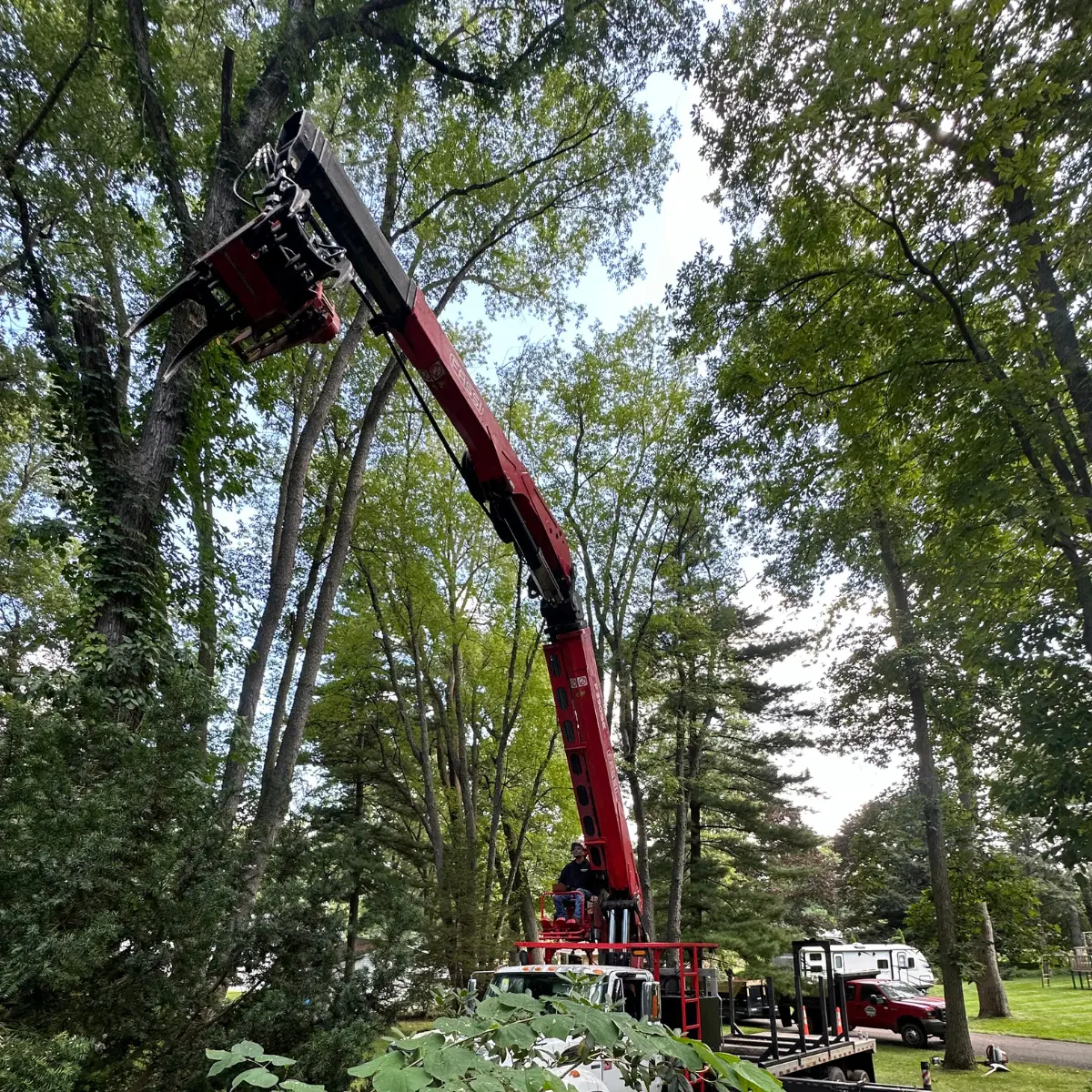
Cabling is worth considering instead of removal when a mature oak has a sound trunk and roots but a weak limb union, usually from codominant stems or included bark rather than decay. In that case, a steel cable high in the canopy can share the load between heavy limbs and keep a weak union from splitting in a storm, which can add years to a valuable tree. If the trunk or roots are failing, though, cabling won’t save it. Here’s how to tell which situation you’re in, for oaks and other big shade trees across Battle Creek and Calhoun County.
What does tree cabling actually do?
Tree cabling links two major limbs or leaders with a high-strength steel cable so they share stress and can’t separate too far under load. Set high in the canopy, it’s designed to keep a weak union from splitting during wind or ice, not to stop the tree from moving. A healthy tree needs to flex.
The hardware matters. We install engineered cables and fittings sized to the tree and placed to recognized standards. Tying a rope or chain between two branches is not a substitute, it cuts into the bark and does more harm than good. Done right, cabling is a precise structural fix, not a quick patch.
Why are mature oaks often good cabling candidates?
Mature oaks are good candidates because of how they grow. Many large oaks, along with maples and elms, develop two or more big codominant stems instead of one central trunk, and over time those tight unions can trap bark between them. That trapped bark, called included bark, weakens the joint even when the wood itself is perfectly healthy.
When a weak union comes from growth habit rather than decay, it’s exactly the kind of problem cabling is built for. The limbs are sound, the attachment is the weak link, and a cable reinforces that link. That’s why a mature, otherwise healthy oak with a wide, heavy canopy is often a strong candidate.
What are the signs an oak may be worth cabling?
An oak is often worth cabling when its trunk and roots are solid but a major union shows early signs of weakness. The health of the trunk and roots is the deciding factor, since a cable only reinforces the union it’s attached to. Look for these signs:
- Included bark at a major union: bark pinched in a tight V between two large limbs or stems weakens the joint, and catching it early allows preventive support
- Heavy, wide-spreading limbs: long horizontal branches put leverage on their attachment points, and a cable can take some of that load off
- Storm stress without failure: a tree that came through a storm but shows cracking or slight separation at a union may benefit from reinforcement
- A sound trunk and root system: this is the most important one, because cabling can’t fix problems below the union
If you’re seeing these, a professional inspection confirms whether the union is a good target, which we walk through in our post on the red flags we check in a tree inspection.
When is cabling not the right choice?
Cabling is the wrong choice when the problem is in the trunk or the roots, not just a limb union. Significant trunk decay undermines the very wood a cable anchors to, so there’s nothing solid to support. Substantial root damage or instability puts the whole tree at risk no matter what you do in the canopy.
A union that has already split or is actively separating is usually past cabling too, and that limb or the tree itself often needs to come down. When several problems stack up at once, like included bark at multiple unions plus some trunk decay, the risk profile changes, and removal may be the safer call. Our guide on how to tell if a tree can be saved or needs removal helps you weigh it.
Is cabling a one-time fix?
No, cabling is an ongoing commitment, not a one-time install. The system needs periodic inspection, tension checks, and occasional adjustment as the tree grows and the limbs add weight. A cable that’s never checked can loosen or get outgrown, which defeats the purpose.
That’s worth knowing before you decide, since it factors into the long-term cost. We schedule follow-up checks on any tree we cable, usually as part of regular maintenance, so it keeps doing its job for years.
Is cabling worth it compared to removal?
For a mature oak, cabling is often worth it, because a tree that took decades to grow can’t be replaced quickly. A large oak provides shade, cuts energy costs, adds real property value, and gives a yard character that a young replacement won’t match for a generation. If the trunk and roots are sound, spending on support to keep that tree is usually money well spent.
For a young or average tree, the math flips. Those are easier and cheaper to replace than to maintain with hardware, so cabling rarely makes sense. The value of the specific tree, weighed against the cost of installing and maintaining the support, is what settles it. Cabling and bracing are also part of the broader storm-prep options we cover in our storm damage prevention guide.
How do you decide? Get a professional assessment
The decision comes down to a professional assessment of the whole tree, not just the union in question. We evaluate the limb unions and any included bark, the trunk condition, the root stability, and the overall structure before recommending anything. From there, cabling might be the answer on its own, paired with some structural pruning to reduce load, or ruled out in favor of removal.
Whatever the plan, it follows the ANSI A300 standards for this kind of work, and the International Society of Arboriculture’s guidance on support systems is a good primer if you want to understand the approach. The point of the assessment is simple: keep the tree if it’s safe to keep, and be honest when it isn’t.
Frequently asked questions
What is tree cabling and how does it work?
Tree cabling connects two major limbs or stems with a high-strength steel cable set high in the canopy. It lets the limbs share stress and keeps a weak union from separating too far in wind or ice, without stopping the tree’s natural movement.
Is cabling permanent?
No. A cable system needs periodic inspection, tension checks, and adjustment as the tree grows. It’s an ongoing form of care, not a set-and-forget fix.
Can cabling fix a tree with trunk decay?
No. Cabling only supports the union it’s attached to. If the trunk is decayed or the roots are failing, there’s no sound wood for the system to rely on, and removal is usually the safer choice.
Will cabling stop my oak from failing in a storm?
It reduces the risk but can’t eliminate it. Cabling strengthens a specific weak union, which lowers the chance of that union splitting, but no system makes a tree storm-proof.
Is cabling cheaper than removing the tree?
Over the long run it often is, especially for a large, valuable oak that would be expensive to remove and impossible to quickly replace. Costs vary with the tree and the hardware, so an on-site quote is the only accurate number.
How often should a cabled tree be inspected?
At least once a year, and after any major storm. Regular checks make sure the cable is still at the right tension and still sized correctly as the tree grows.