Every week, property owners in Battle Creek and across Southwest Michigan call us after a tree has failed.
The tree had problems for years. They knew something was off. They kept meaning to call. They waited for spring, then summer, then fall. Then a storm made the decision for them, and now there is a fallen tree on a fence, a roof, or a vehicle.
Timing matters enormously in tree removal, both for safety and cost. The right window saves money, reduces disruption to your property, produces cleaner work, and eliminates the risk of an unscheduled emergency.
Here is what Southwest Michigan property owners need to know about when to act, and why.
What Is the Best Time of Year for Tree Removal?
The best time of year for tree removal in Southwest Michigan is the dormant season, which runs from late November through early March. During dormancy, trees have dropped their leaves, making structural assessment easier, site access cleaner, and debris removal more manageable. Frozen or firm ground also reduces lawn damage from equipment. This window consistently produces the most efficient and cost-effective results.
Why Does Tree Removal Timing Matter in Michigan?
Michigan’s climate creates genuine seasonal differences in how tree removal is performed and what it costs. Summer removal requires managing full canopy weight, soft soil conditions, and higher crew demand. Winter dormant removal benefits from clear sightlines, firm ground, lighter debris loads, and crews scheduling ahead rather than responding to post-storm backlogs. Choosing the right window reduces cost, property disruption, and overall risk.
When Should You Stop Waiting and Schedule Tree Removal?
Schedule tree removal as soon as a professional assessment identifies a hazard, dead tree, structurally compromised union, significant decay, or root failure. Do not base your timing on the season alone. A tree with active hazard signs needs to come down regardless of the calendar. Dormant-season scheduling is ideal for planned removal of known problem trees, not a reason to delay action on an urgent situation.
Key Takeaways:
- Late November through early March is the optimal scheduling window for planned tree removal in Southwest Michigan.
- Dormant-season removal offers better structural visibility, firmer ground, and lower site disruption.
- Some tree species, particularly oaks, have species-specific timing requirements related to disease risk.
- Crews are often more available in winter, which means faster scheduling and sometimes lower cost.
- Hazardous trees should be removed immediately regardless of the season.
- Pre-season assessment in late fall prevents emergency removal costs when spring storms arrive.
Why the Dormant Season Is the Best Window for Tree Removal in Southwest Michigan:
Clearer Sight Lines and Better Structural Assessment:
When leaves are gone, everything is visible.
Branch unions, dead wood, structural cracks, and co-dominant stem problems that are partially hidden by summer canopy become fully accessible in winter. In our experience, dormant-season assessments on Battle Creek properties regularly reveal structural issues that were missed during summer walk-throughs.
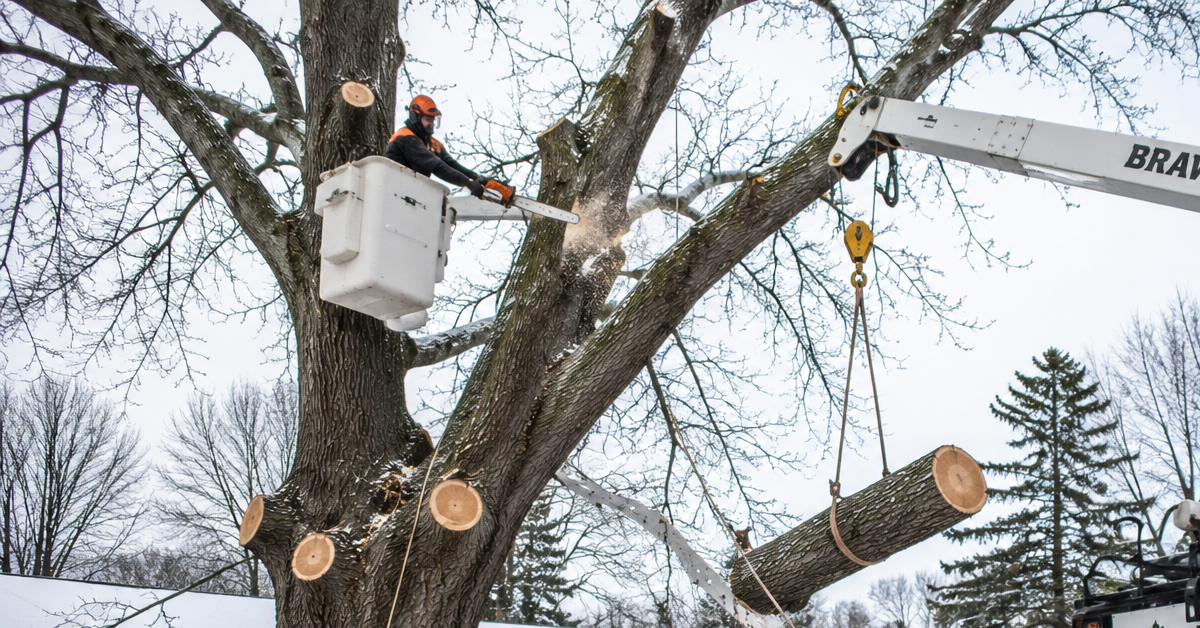
Better visibility also means cleaner, more controlled removal. Crews can see exactly where limbs will fall, position equipment more accurately, and manage the drop zone with far greater precision.
Firmer Ground Means Less Property Damage:
Many Southwest Michigan property owners are surprised to discover that winter removal actually causes less lawn and landscape damage than summer work.
Michigan’s clay-heavy soils become saturated in spring and summer. Running heavy equipment across soft ground creates deep ruts, compaction, and lawn damage that can take a full growing season to repair.
Frozen or firm winter ground supports equipment weight without damage. For properties with manicured lawns or established landscaping near the tree, scheduling removal in December through February often results in a significantly cleaner job site.
Lower Crew Demand and Better Scheduling Availability:
Summer is the busiest season for tree services throughout Southwest Michigan.
Post-storm call volume from spring and summer weather events fills schedules quickly. Properties waiting for scheduled removal often face weeks-long delays when storm damage creates competing demand for crews.
Winter scheduling typically offers faster turnaround, more crew flexibility, and in some cases lower rates as companies manage slower-season workload. A common issue on Southwest Michigan properties is homeowners waiting until after a storm to schedule work that should have been done months earlier, paying both emergency rates and extended wait times.
Key Takeaway: Scheduling tree removal proactively during the dormant season gives you better access to crews, better conditions, and better results than scheduling reactively after storm damage.
Species-Specific Timing Considerations for Michigan Properties:
Not all trees follow the same removal calendar. Several Michigan tree species have timing requirements driven by disease risk.
Oak Trees and Oak Wilt:
Oak wilt is a serious fungal disease that affects red oak species throughout Michigan, including Calhoun County and surrounding areas.
The disease spreads through root grafts between neighboring oaks and through sap-feeding beetles that are active from April through July. Fresh pruning cuts and wounds made during this period attract these beetles, which can introduce oak wilt to a healthy tree.
For oak removal or pruning on Southwest Michigan properties, the safest window is July 15 through March 15. Avoid making cuts on oaks during peak beetle activity in late spring and early summer unless the removal is absolutely necessary. If an oak must come down during the high-risk window, immediate wound treatment is essential.
This is one species-specific detail that many property owners and inexperienced crews overlook entirely. In our experience, oak wilt spread from improper removal timing is one of the more preventable tree losses we see in the Battle Creek and Marshall areas.
Emerald Ash Borer Considerations:
Ash trees throughout Michigan are heavily affected by emerald ash borer, an invasive insect that has killed tens of millions of ash trees statewide.
If you have ash trees on your Southwest Michigan property, there is a strong probability they are either already infested or are candidates for treatment. For ash removal specifically, timing is less driven by season than by the urgency of the tree’s structural condition. Dead ash trees deteriorate rapidly, becoming increasingly difficult and dangerous to remove the longer they stand. We frequently see ash trees in Battle Creek and across Calhoun County that homeowners delayed removing for a season or two too long, leaving a tree with significant structural unpredictability.
For ash trees, do not wait for the ideal seasonal window. Get them assessed and scheduled as soon as possible.
The Michigan DNR Forest Resources Division provides detailed guidance on emerald ash borer management and ash tree assessment for Michigan property owners.
What to Do Right Now, Whatever Season You Are In:
The most important step is scheduling a professional tree health care assessment of any tree you have been watching with concern.
If that assessment identifies a tree that needs to come down, schedule the removal immediately. Do not let the calendar decide for you. A tree that is structurally compromised in June is not going to become safer by November.
If the assessment identifies trees that are high-risk but not yet at the removal threshold, scheduling removal during the coming dormant season is the right move. That gives you time to plan the budget, confirm crew availability, and handle stump removal and any follow-on landscape work without emergency pressure.
Professional tree care, as applied in the standards developed by the tree care industry, is fundamentally proactive work. The homeowners who consistently spend the least on tree service over time are the ones who schedule assessments regularly and address problems before they escalate.
Many property owners are surprised to discover how much their post-removal plans change once a tree is actually down. Stump location, sun exposure to garden areas, neighboring tree health, and drainage patterns all shift when a significant tree is removed. Planning that process during the dormant season allows for a more thoughtful outcome.
Key Takeaway: The best time to schedule tree removal is as soon as a professional assessment identifies the need. The dormant season is the best window for planned, non-urgent removal. There is no good reason to wait.
The Cost of Waiting Too Long:
We get calls every spring from Southwest Michigan property owners who describe what happened to a tree they had been watching for two or three years.
The pattern is consistent. They noticed something wrong in the spring. They were busy. They planned to deal with it in the fall. Fall came, and the tree still looked mostly okay, so they decided to wait until spring again. Then a February ice storm or an April windstorm made the decision for them.
Emergency removal of a large tree costs significantly more than scheduled removal. It may involve crane work, after-hours crew, or complex rigging over a structure that would have been a straightforward felling job if the tree had been addressed while still standing safely.
That cost difference, multiplied across the number of homeowners who delay addressing known problem trees, is one of the main reasons professional emergency tree service exists.
For properties where multiple trees may need attention, a seasonal review by a qualified professional can help prioritize which trees need removal this dormant season, which can wait, and which need ongoing monitoring through tree health care management.
The certified arborist credential, developed through the International Society of Arboriculture, establishes the training standard for professionals performing tree risk assessments. When you are deciding which trees to remove and when, those assessments matter.
Planning the Full Scope: Removal, Stump, and What Comes After:
Tree removal is rarely just about the tree.
Once a tree comes down, the stump remains. For most residential properties in Battle Creek, Albion, and Kalamazoo County, leaving a stump in place limits how the yard space can be used, allows for potential regrowth from root suckers, and can create a tripping hazard.
Scheduling stump removal at the same time as the tree removal reduces mobilization costs and eliminates the need for a second visit.
For properties where multiple trees are being removed or where larger areas need to be cleared, combining tree removal with land clearing services in a single planned project is typically more cost-effective than scheduling each component separately.
Key Takeaway: Plan the full scope of post-removal work, including stump grinding and site cleanup, at the same time you schedule the tree removal. It is almost always more efficient and less expensive.
Frequently Asked Questions:
Can trees be removed in winter in Southwest Michigan?
Yes, and winter is often the best time. Frozen or firm ground causes less lawn damage from equipment. No foliage means cleaner debris management and better visibility for the crew. Crew availability is typically better in winter than during the post-storm summer rush. Many of our cleanest removal jobs in Battle Creek and Calhoun County happen between December and February.
How much does tree removal cost in Southwest Michigan?
Cost depends on tree size, location, proximity to structures, access, and whether stump removal is included. Small trees under 30 feet typically run a few hundred dollars. Large mature trees near structures can run significantly more. Emergency removal carries additional costs. The best way to get an accurate number is a professional on-site estimate.
Should I remove a tree before or after winter?
Before winter is the safer choice for any tree showing signs of structural compromise. Michigan’s ice storms and freeze-thaw cycles actively worsen pre-existing weaknesses. A tree with cracked bark, a split union, or significant dead wood heading into winter is a tree that is more likely to fail by spring. Remove it in fall rather than hoping it makes it through another Michigan winter.
When is it too late to save a dying tree in Southwest Michigan?
A tree with dead wood throughout the crown, a hollow or severely decayed trunk, significant root system failure, or bark separation around more than half the trunk circumference is generally past the point of restoration. Trees with partial crown dieback or localized decay may still be candidates for treatment and monitoring. A professional tree health assessment is the only reliable way to determine which category your tree falls into.
Can I remove a tree from my property myself in Michigan?
Small trees under 15 feet with no proximity to structures, utilities, or public areas can sometimes be handled by a homeowner with proper equipment and knowledge of safe felling direction. Any tree near a structure, utility line, vehicle, or with visible decay or structural compromise should be handled by a professional. The stored mechanical energy in a falling tree, and the unpredictability of structurally compromised wood, creates serious injury risk for untrained workers.
Is it true that trees should not be removed during certain months?
For certain species, yes. Oak trees should ideally not be cut between approximately April and July 15 due to oak wilt risk from sap-feeding beetle activity during that period. For other species, timing is more flexible, though dormant-season removal is generally preferred for the practical reasons discussed in this article.
If You Have a Tree You Have Been Watching, Now Is the Time to Act:
There is no prize for waiting.
A tree that concerns you this fall will concern you more next spring. A compromised tree that survives this winter may not survive the next ice storm, the next windstorm, or the next heavy wet snow event that Southwest Michigan reliably delivers.
The homeowners who consistently manage their tree inventory without emergencies share one habit: they schedule annual assessments and address problems proactively. They do not wait for a storm to make the decision.
At Brawner’s Tree Service, we work with property owners throughout Battle Creek, Calhoun County, Marshall, Albion, Springfield, and broader Southwest Michigan to assess, plan, and execute tree removal at the right time, before it becomes an emergency.
If you have a tree you have been considering for removal, contact us now to schedule your assessment. We will tell you honestly what needs to come down this season, what can wait, and what needs to be monitored.
Contact Brawner’s Tree Service to schedule a tree assessment or removal in Southwest Michigan.
Visit brawnerstreeservice.com or call us today.