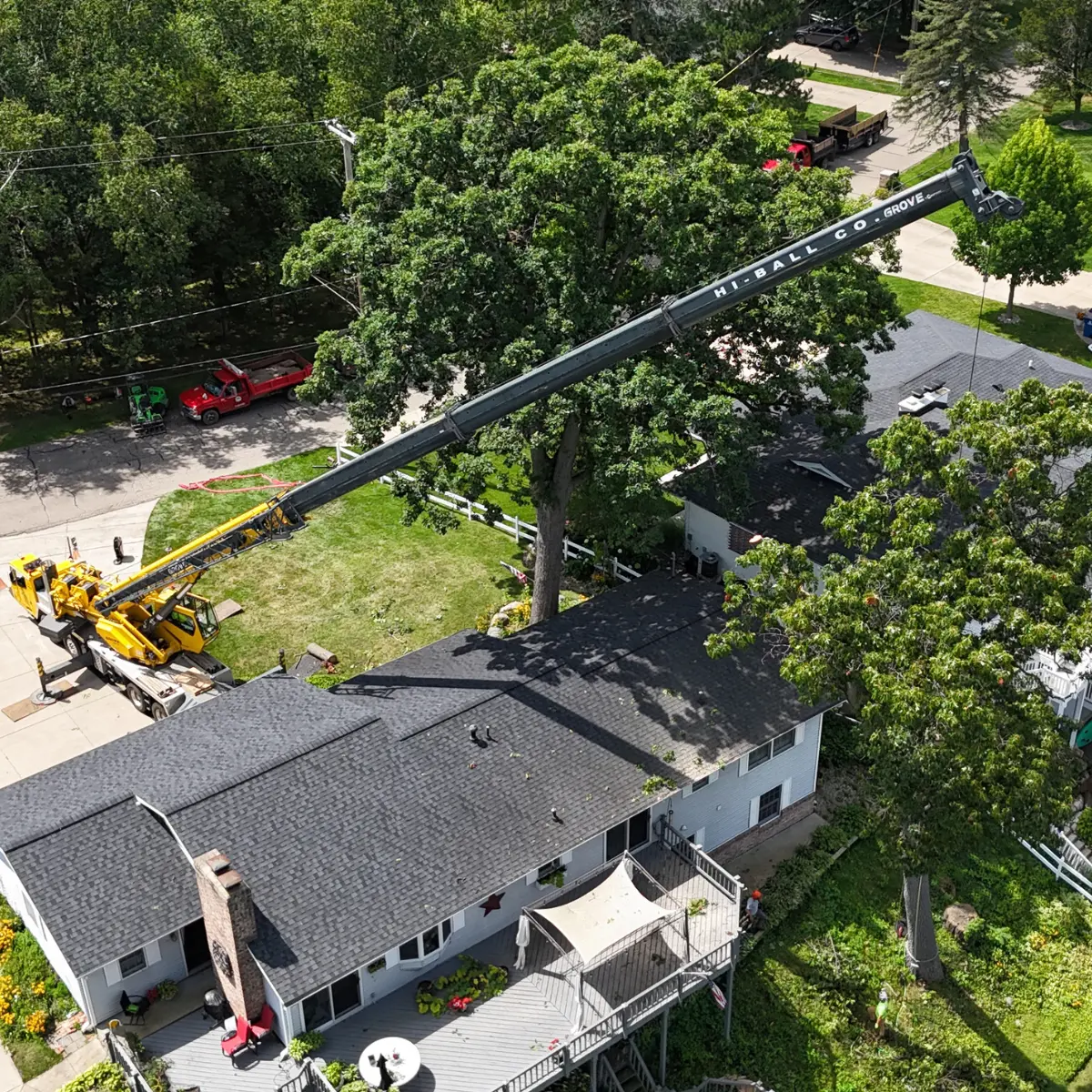
An emergency tree removal moves fast but follows a careful order: our crew assesses the site for hazards, secures the area and a drop zone, rigs and cuts the tree to release the tension in damaged wood, lowers or craning out the heavy sections under control, and then clears the debris and documents the damage. Each step exists to keep people and property safe while a compromised tree comes down. Here is what actually happens on an emergency job in Battle Creek, from the moment we pull up to the final cleanup.
What happens first when our crew arrives?
The first thing we do is assess the site before anyone touches the tree. We look for what makes the job dangerous: power lines, gas meters, the direction the tree is leaning or already failing, and how much tension is locked in cracked or bent wood. From that we set a drop zone, the cleared space where sections of the tree can come down safely.
This assessment is where most of the safety happens. A storm-damaged tree holds forces that are not obvious from the ground, and cutting in the wrong order can release them all at once. Reading the tree first is what lets the rest of the job go in a controlled way.
How do we handle a tree near power lines?
We treat every power line as energized until the utility confirms otherwise. If a damaged tree is on or near lines, we coordinate with the utility, which in our area is usually Consumers Energy, before any cutting begins. A downed or contacted line can carry a lethal current through the tree and the ground around it.
This is also why an emergency tree near lines is never a do-it-yourself job. Consumers Energy advises staying far back from any downed line and assuming it is live, and reporting it immediately. Our crews are trained to work around utility hazards and to wait for the utility when a line is involved, rather than risk it.
How do we safely take the tree down?
We take the tree down in controlled pieces using rigging, not by felling it in one drop. A climber or bucket operator works from the top, and we use high-tensile rope, pulleys, and friction devices to lower each section slowly into the drop zone. On large or awkward trees, a crane or grapple truck lifts sections out instead.
The key move on storm-damaged wood is releasing the stored tension safely. A bent or partly split trunk is under load, so we make specific cuts in a set order to let that tension off gradually. Throughout, a ground person keeps eyes on the climber and the drop zone and stays in contact by helmet headset, so the whole crew moves as one.
What equipment do we use on an emergency job?
The equipment depends on the tree and the site, but an emergency job usually calls for heavier gear than routine work. A storm removal moves faster and safer with the right machines rather than hand-cutting a dangerous tree piece by piece.
Common equipment on an emergency removal includes:
- A crane or grapple truck to lift heavy sections away from structures
- Rigging gear: high-tensile rope, pulleys, and friction devices for controlled lowering
- High-capacity chippers to process debris on site
- Helmet headsets so the climber and ground crew stay in constant contact
- Full protective equipment for a hazardous, fast-moving work zone
What happens after the tree is down?
Once the tree is safely down, we clear the debris and document the damage. Branches and smaller wood go through the chipper, larger sections are cut and removed, and we clean the work area so your property is safe to use again. If you want the stump gone too, we can grind it as a follow-up.
We also document the damage before and after, which matters for insurance. Clear photos and notes of what failed and what it affected support your claim, and our guide on whether home insurance covers fallen tree damage explains what Michigan homeowners can usually expect.
When should you call for emergency tree removal?
Call for emergency removal when a tree has fallen on or against a structure, is leaning or split after a storm, is tangled in power lines, or is blocking access and could shift. These situations do not wait for a scheduled appointment, which is why our 24/7 emergency tree service runs around the clock across Battle Creek and Calhoun County.
If the tree is damaged but still standing and not an immediate threat, it may not be a true emergency. Our guide on what to do if a storm damages your tree helps you tell the difference before you call.
Frequently asked questions
How fast can you respond to an emergency tree removal?
Our emergency line runs 24/7, and we prioritize jobs where a tree is on a home, blocking access, or near power lines. Response time depends on conditions, since a large storm can create many emergencies across Battle Creek at once.
Is emergency tree removal more expensive than a scheduled removal?
It usually costs more because of the after-hours response, the added risk, and the heavier equipment a damaged tree requires. The exact price depends on the tree’s size, location, and how much hazard is involved.
Should I move my car or anything before you arrive?
If you can do so safely, move vehicles and valuables out of the area and keep people and pets away from the tree and any downed lines. Do not go near a line or under a leaning tree to retrieve anything.
Can you remove a tree that has fallen on my house?
Yes, that is one of the most common emergency calls we handle. We stabilize and remove the tree in controlled sections to avoid adding damage, often using a crane to lift it off the structure rather than cutting it where it sits. We document the damage as we go for your insurance claim.
Does homeowners insurance cover emergency tree removal?
Often yes, especially when the tree has hit a covered structure like your house, garage, or fence. Coverage and limits vary by policy, so keep our before-and-after photos and the invoice for your claim. Our guide on whether home insurance covers fallen tree damage goes into what Michigan homeowners can usually expect.