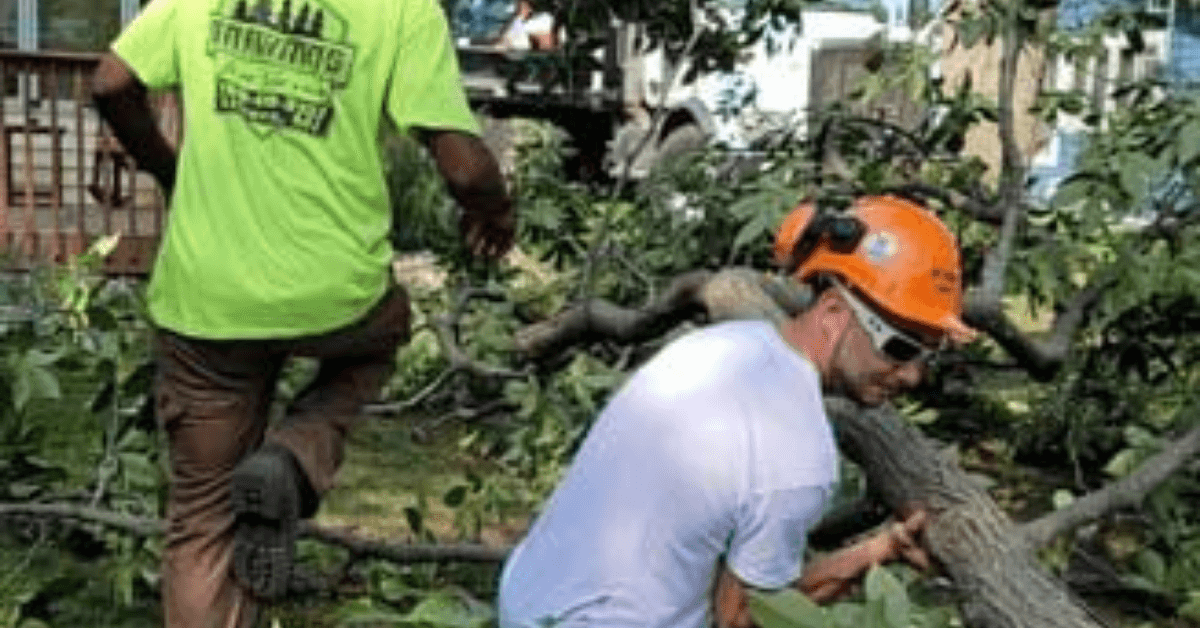
You prevent storm damage to your trees by getting them inspected, pruning for wind strength, caring for the roots, adding cabling or bracing where it’s needed, replanting with sturdy species, and having a plan for when a storm hits. A healthy, well-structured tree bends and holds in wind and ice. A neglected one drops limbs or comes down on your house. We help homeowners protect their trees across Battle Creek, Marshall, Albion, and the rest of Calhoun County, and here’s how to get yours ready before the next storm.
Why does storm preparation matter?
Storm preparation matters because most tree failures are preventable, and the damage one tree can do far outweighs the cost of caring for it. A limb through your roof, a trunk on your car, or a tree in a power line all start as a weak spot that was there before the storm. Prep finds and fixes those weak spots while it’s cheap and safe to do so.
There’s an upside beyond safety too. Well-kept trees hold their shade, control erosion, and add value to your property, while a tree that fails takes all of that with it. In Calhoun County, where we see wind, ice, and saturated clay soil every year, that prep pays off often.
The first step is a professional inspection, ideally once a year before storm season. An arborist checks what you can’t see from the ground: cracked or weak branch unions, root heaving, hidden decay, and limbs that have grown too long for their own strength. From there you get a clear plan on what to prune, support, or remove.
This is where most of the prevention happens, because the fixes are small when a problem is caught early. We walk through exactly what we look for in our guide to the red flags we check during a Battle Creek tree inspection.
Step 2: Prune for strength and safety
Pruning for storms means removing the weak, dead, and overextended wood so wind passes through the canopy instead of pushing against it. We take out deadwood, crossing limbs, and weak junctions, and we thin the canopy enough to cut wind resistance while leaving the tree plenty of foliage to stay healthy.
How it’s done matters as much as that it’s done. Over-pruning or topping a tree makes it weaker and forces fast, poorly attached regrowth that fails in the next storm. Proper pruning follows the ANSI A300 standard, and our tree trimming crew works to it.
Step 3: Care for the root zone
A tree is only as stable as its roots, so storm prep includes the soil. Spread two to three inches of organic mulch over the root zone to hold moisture and protect the roots, but keep it off the trunk, since mulch piled against the bark invites rot. On the heavy clay common around Battle Creek, aerating compacted soil and improving drainage in low spots helps roots breathe and anchor.
Protect the root zone the rest of the year too. Keep heavy equipment and construction traffic off the soil over the roots, since compaction there quietly weakens a tree long before a storm tests it.
Step 4: Install support systems when a tree needs them
Support systems like cabling and bracing hold weak or valuable trees together through a storm, lowering the chance a heavy limb or split trunk fails. We install them before storm season on large, mature, or structurally weak trees, and only a trained pro should do it, since the wrong placement or tension adds stress instead of relieving it. There are a few types, and the right one depends on the tree:
- Cabling: high-tensile steel cables set in the upper canopy reduce strain between heavy limbs. It works best on multi-trunk trees and species with long horizontal branches, like maples.
- Bracing: steel rods run through a weak branch union or a split trunk to stop it separating further. We use it on older oaks and elms that are worth keeping.
- Staking and guying: temporary support for newly planted or relocated trees while the roots establish, then removed.
- Dynamic systems: flexible materials that let the tree sway naturally while limiting excessive movement, so it keeps growing normally.
A tree is usually a candidate for support if you notice any of these:
- A lean or soil shifting at the base
- Cracked bark or a split in the trunk
- Overextended limbs or a tight, V-shaped trunk union
- Recent transplanting or nearby construction
- Branches that keep failing after wind or ice
Catching these early is the whole point, since a cable installed in fall is far cheaper than an emergency removal after the limb comes down.
Step 5: Choose storm-resilient species when you replant
When you plant or replace a tree, species choice is a long-term form of storm prep. Some trees stand up to Michigan wind and ice far better than others. Silver maples and birches, for example, are prone to splitting under ice load, and Michigan State University Extension notes that ice accumulation is particularly hazardous for them, so they often need structural pruning to hold up.
Lean toward native, storm-tolerant species suited to Battle Creek, and plant a mix rather than a row of the same tree. A diverse canopy limits how much you lose to any single storm, pest, or disease, and it keeps your property greener over the long run.
Step 6: Have a storm response plan
Even a well-prepped property needs a plan for when a storm still does damage. Know who to call before you need them, keep a professional tree service’s number handy, and understand how to check your trees safely once the weather clears. Photograph your trees in good condition now, so you have a before-and-after record if you ever file a claim.
After a storm, stay well clear of any tree touching a power line and watch for hanging limbs and lifted soil. Storm-damaged wood can hold hidden tension, and OSHA warns that cutting it can cause sudden, dangerous movement, so leave it to a crew with the right training and gear. Our 24/7 emergency tree service covers Battle Creek and all of Calhoun County, and our guide on whether home insurance covers fallen tree damage explains what to expect on a claim.
A year-round storm-prep calendar for Battle Creek and Calhoun County
The strongest storm prep runs all year, not just before a forecast. Prune and feed in spring, water and watch for pests in summer, add supports and inspect in fall before the high-wind season, and protect trees from ice in winter. Here’s the simple rhythm:
- Spring: prune winter damage, test the soil, fertilize, and refresh mulch.
- Summer: water deeply about once a week during dry spells, watch for borers and beetles, and trim any hazardous limbs.
- Fall: install cabling or bracing before wind season, mulch the root zone, and schedule a full canopy inspection.
- Winter: let ice melt on its own or clear it gently with warm water rather than knocking it off, keep heavy snow off young trunks, and limit de-icing salt near the roots.
Keep to that rhythm and you’re not scrambling before every forecast. Your trees go into each storm season already in good shape.
Frequently asked questions
How often should trees be inspected for storm readiness?
At least once a year, ideally in fall before the high-wind and ice season, plus a check after any major storm. Large trees near your home and older trees should be looked at more often.
Does pruning really reduce storm damage?
Yes, when it’s done right. Proper pruning removes the weak and dead wood that fails first and thins the canopy so wind passes through instead of pushing the whole tree. Topping or over-pruning does the opposite and makes a tree more dangerous.
Will cabling hurt my tree?
No. Properly installed cabling and bracing support a tree without harming it. The risk comes from poor placement or incorrect tension, which is why it should only be installed by a trained professional.
Can a storm-damaged tree be saved?
Often, yes. A tree with minor limb loss or a repairable split can frequently be saved with pruning, cabling, or bracing. Trees with major trunk, root, or canopy damage usually need removal, which an inspection will determine.
What should I do right after a storm?
Stay away from any tree touching a power line, watch for hanging limbs, and check the base for lifted or cracked soil from a safe distance. Photograph the damage for insurance, then call a professional rather than cutting storm-loaded wood yourself.
Do you serve all of Calhoun County?
Yes. We provide storm prep, inspections, pruning, cabling, and emergency tree service across Battle Creek, Marshall, Albion, and the surrounding Calhoun County area.